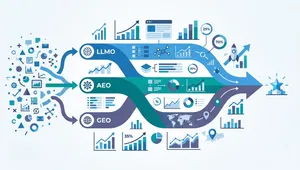
The 2026 Digital Marketing Top 10 Trends Are In: 3 to Pick Up and 3 to Drop for Your Solo GEO Strategy
From Search Engine Journal's 2026 Top 10 trends, here are the 3 initiatives solo marketers should focus on this term and the 3 you can confidently let go. The hands-on update to the GEO series.
What you'll learn in this article
- What changed in AI search and content discovery
- Which metric or operating rule matters before shipping more content
- Which follow-up article expands the strategy from another angle

“So in the end, what should I focus on in 2026?”
This has been the most common question I’ve heard in consultations over the past two weeks. Last month, Search Engine Journal (SEJ) released its “Top 10 Digital Marketing Trends for 2026,” and many readers were left scratching their heads (Search Engine Journal “The Top 10 Digital Marketing Trends For 2026”).
In SEJ’s original piece, the ten themes are framed as things like “Conversational Search Redefines SEO” and “The Video-Commerce Boom.” Translated into operational language, those ten axes become: GEO readiness, Agentic SEO, video-first, AI Overview countermeasures, zero-click search response, first-party data utilization, personalization, short-form video, voice search, and the redefinition of influencers (this naming is my own practical reframing). The moment those ten axes line up, a solo marketer’s time budget collapses.
I work alone myself, so I get the feeling. I’m not going to tell you “do all of them.” Out of the ten, a solo marketer should pick up only three this term. The rest have entered a phase where it’s fair to scale back or pull out entirely.
In this article, I’ll share the “pick up 3, drop 3” framework I used when I updated my own GEO strategy to the 2026 edition. By the time you finish reading, you should be able to walk away with a single concrete list telling you what to start and what to stop on Monday morning.
Why “do everything” no longer works: it’s a time-budget question
Before anything else, let me share the premise: why does reaching for all ten lead to collapse?
The average disposable time for a solo marketer—covering content production, analysis, and operations combined—is around 20 hours per week. This is my felt sense from talking with more than 100 individual marketers over the past year. Whether you’re a salaried employee carving out time around your day job or a freelancer fitting it between client work, the slot you can secure tends to land around that scale.
Chase all ten trends evenly and you get just two hours per initiative per week. That’s not enough volume for either skill-building or results. Even GEO alone—including content structuring, optimization for AI crawlers, and citation-rate measurement—needed about eight hours a week for the first three months in my experience.
What works here is “the decision to stop.” Unless you weigh “pick up” and “drop” with equal seriousness, you can never start anything new. Launching a new initiative has to be paired with stopping an existing one—otherwise, in a solo time budget, it physically doesn’t add up.
What I actually decided this term was to scale back three initiatives and pour time into three others. When you re-sort SEJ’s ten trends along two axes—“size of impact” and “realistic feasibility for one person”—the answer narrows down on its own.
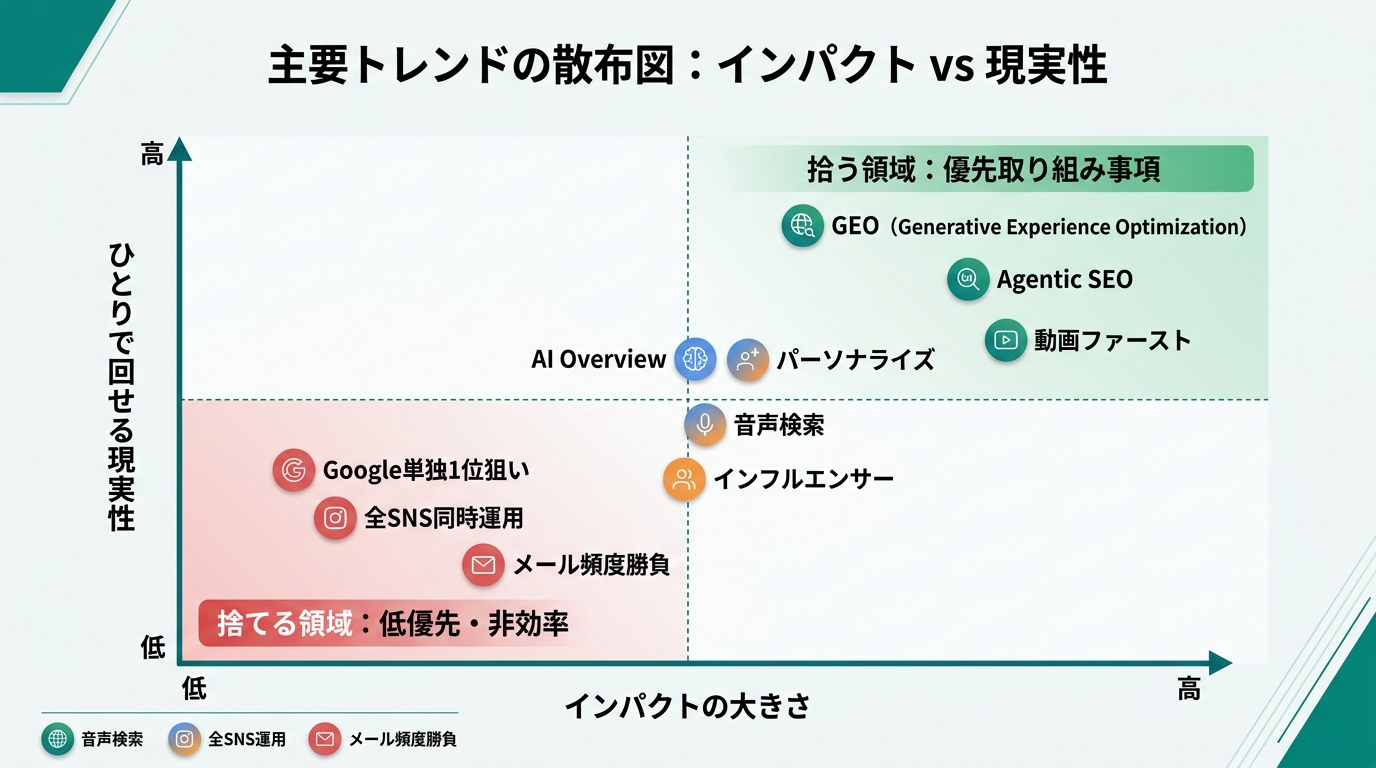
From here, let’s look at the three to pick up and the three to drop in order.
Pick up #1: GEO (Generative Engine Optimization) shifts from “insurance” to “main act”
GEO is the practice of optimizing your content to be more easily cited by generative AI search. The targets are major LLMs like ChatGPT, Claude, Gemini, and Perplexity. You can think of it as the switch from the SEO mindset of “ranking #1 in search results” to the mindset of “being cited in AI answers.”
There are three reasons GEO tops the priority list.
The first is the speed at which traffic structure is changing. Data introduced by Search Engine Land citing a Previsible study showed that site traffic via large language models grew 527% year-over-year over the past 12 months (Search Engine Land “AI traffic is up 527%”). Investing in GEO is no longer “insurance for the future”—it’s “the main battlefield for this term.”
The second is that the work has shrunk down to a scale a solo marketer can handle. A year ago, GEO was still highly specialized—crawler analysis, schema implementation, citation-rate measurement—and basically presupposed outsourcing. Today, by using major LLMs like ChatGPT, Perplexity, and Gemini, you can measure how often your own site is cited once a month, on your own.
The third is the compounding nature of the work. A single GEO-ready article gets evaluated simultaneously across four entry points: Google Search, AI Overview, ChatGPT, and Gemini. Compared to an SEO-only article, the same amount of work creates four times the exposure opportunity. I’ve already organized this idea as Search Everywhere Optimization (SEvO). This term’s GEO push is the field-tested version of that.
The concrete launch steps come down to three: ① rewrite your top three existing articles to be AI-crawler-ready; ② place easy-to-cite structures (summary, data, sources) at the top; ③ once a month, search your service name on ChatGPT and log the citation rate. These three steps alone can carry you through the first 90 days.
Pick up #2: Agentic SEO—getting found by AI agents
Agentic SEO is optimization for the era when AI agents autonomously crawl the web to gather information or act as purchasing proxies. Think of it as designing your site so it’s easy for an agent to discover and select. It also ranked high on SEJ’s trend list.
Why pick up Agentic SEO right now? Two reasons.
One is that AI agent implementations are exploding. Since Anthropic released its agent platform for Claude, production adoption cases have started showing up at companies both in Japan and abroad (Anthropic “Managed Agents”). As the number of agents grows, so does the gap between sites agents visit and sites they ignore. I wrote up the detailed background in my Claude Managed Agents explainer.
The other is that there are still very few early movers in Agentic SEO. Compared to SEO and GEO, you can count the practical Japanese-language articles on it on one hand. Move this term and you have a strong shot at claiming an early-mover position in search results six months from now.
The first steps a solo marketer should take in Agentic SEO this term boil down to three: ① add a “machine-readable FAQ” to your site; ② build out structured data (Schema.org) for your products and services; ③ experiment with an API-endpoint-style information design that AI agents prefer. Just those three put you at the doorstep of the agent era.
The natural question here is: how is this different from SEO? SEO assumed “humans reading search results.” Agentic SEO shifts the assumption to “AI interpreting and relaying it to humans.” The importance of title tags and heading structures is the same. What has started to shift, little by little, is that “structured facts beat ambiguous metaphors” in evaluation.
Pick up #3: Video-first × AI video generation breaks through the production-cost wall
The importance of video content has been preached since 2024, but solo marketers have always run into the same wall: a lack of production resources. 2026 looks like the inflection point where that wall suddenly drops.
The reason is that AI video generation tools have matured. OpenAI Sora, Google Veo, Runway Gen-4, Luma Dream—the major tools have reached the level where they can output usable-quality video over a minute long from text. Of the three workflow stages—script, shoot, edit—AI now absorbs about 80% of the shoot and edit stages.
I’ve measured the concrete impact myself. A 5-minute explainer made the traditional way takes 2 hours of scripting, 1 hour of shooting, and 6 hours of editing—9 hours total. Once I worked AI video generation into the pipeline, it compressed down to 2 hours of scripting plus 1 hour for AI generation and tweaks—3 hours total. Math says: one-third the cost, three times the volume.
The biggest reason for a solo marketer to pick up video-first is that video exposure slots in search results keep expanding. YouTube Shorts in Google’s top slots. Embedded video inside AI Overviews. TikTok in-app search results. The entry points where video appears have swelled to a scale that rivals text articles.
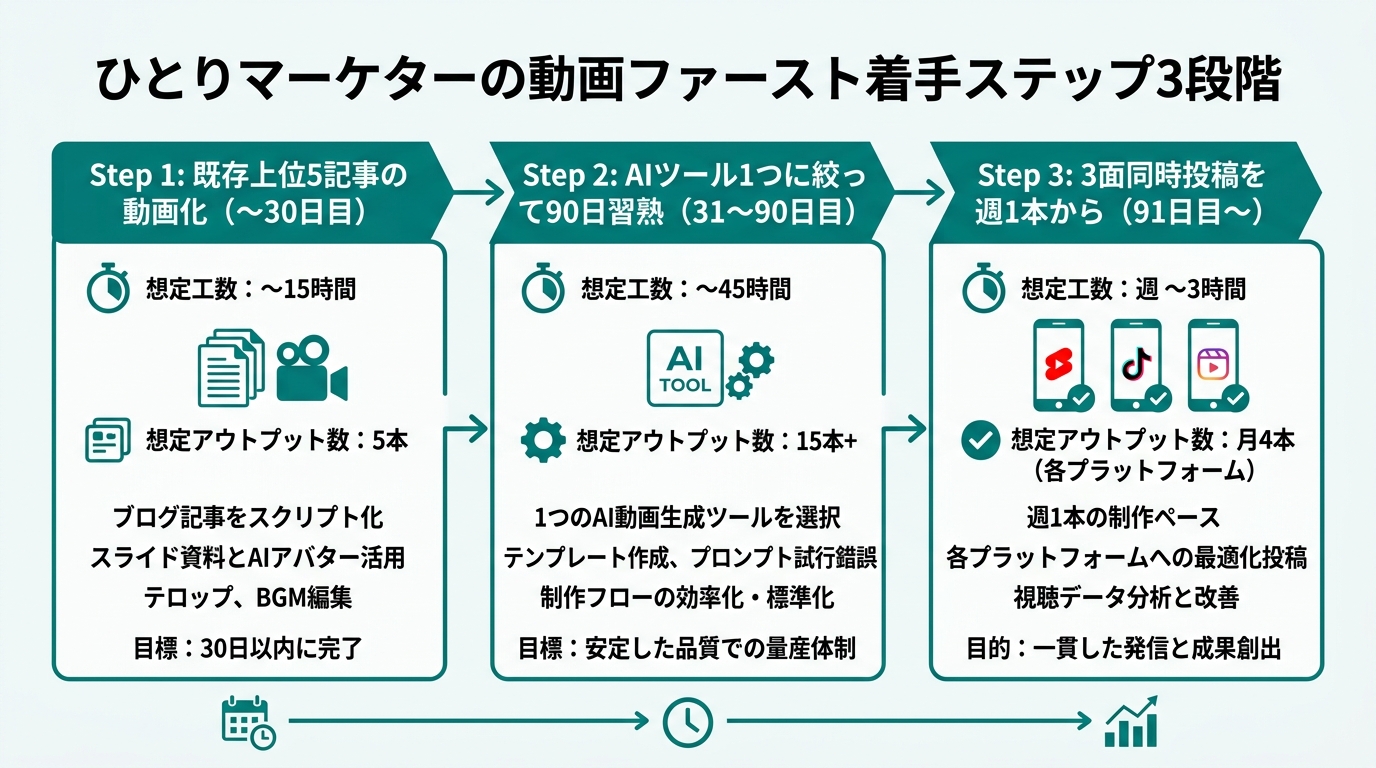
The launch path narrows to three steps: ① convert your top five traffic-generating articles into “3-minute videos”; ② pick exactly one AI video generation tool and spend 90 days mastering it; ③ start with one weekly post simultaneously across YouTube Shorts, TikTok, and Instagram Reels. There’s no need to fan out across multiple platforms in the early stage.
Drop these 3: “Going for #1 on Google alone,” “Running every SNS at once,” “Email frequency battles”
This is arguably the main event. Deciding what to drop is harder than deciding what to pick up.
The first thing you can let go of is the goal of “claiming the #1 slot in Google search results on its own.” As I said, GEO readiness is something you should pick up—but investment in winning #1 on Google itself has entered the phase where it’s fine to scale back. The reason: AI Overview is occupying the top slots, and the traffic value of being #1 has dropped. A study reported by Search Engine Land showed that when AI Overview is displayed, search clicks fell by about 30% (Search Engine Land “Google AI Overviews search clicks fell”).
Specifically, three things you can stop: “checking rank-tracking tools every day,” “rewrites done solely to push keyword rankings up,” and “article swaps to acquire backlinks.” When I redirected the time I’d been spending on these into GEO, my felt sense was that the same effort produced 3 to 4 times the reach.
The second thing you can let go of is the strategy of “running every SNS platform in parallel.” Twitter (X), Instagram, TikTok, LinkedIn, Facebook, note. Updating all of these evenly every week isn’t realistic for a solo marketer. This term, you’ve entered the phase where narrowing to two is fine.
The criterion is: “Are your customers actually making purchasing decisions on that SNS?” For B2B, LinkedIn and Twitter. For B2C aimed at people in their 20s, TikTok and Instagram. For industry-specialist services, X (formerly Twitter) and note. We’ve entered an era where consolidating to two per industry is acceptable. I’ve written up the SEO/SNS division of labor in a separate article in detail.
The third is the strategy of “increasing email newsletter frequency.” The era when you could maintain open rates with three newsletters a week is nearly over. Mailchimp’s published benchmark data confirms a correlation across industries between excessive frequency and dropping engagement (Mailchimp Email Benchmarks). I’ve personally observed multiple cases where switching to once-a-week-or-less cadence improved open rates.
Drop the frequency battle and switch to raising the density per email—just that changes your relationship with readers. The optimal frequency varies by industry and audience, but if you sense you’re “over-sending,” it pays to cut back immediately. People naturally lower the priority of anything that’s always being offered. Creating a “I want more” state is what lifts open rates over the long term.
3 steps to update your GEO strategy to the 2026 edition
Building on the “pick up 3, drop 3” framework above, here’s the concrete procedure I used to rewrite my own solo-marketer GEO strategy for 2026—the actual three steps from this term.
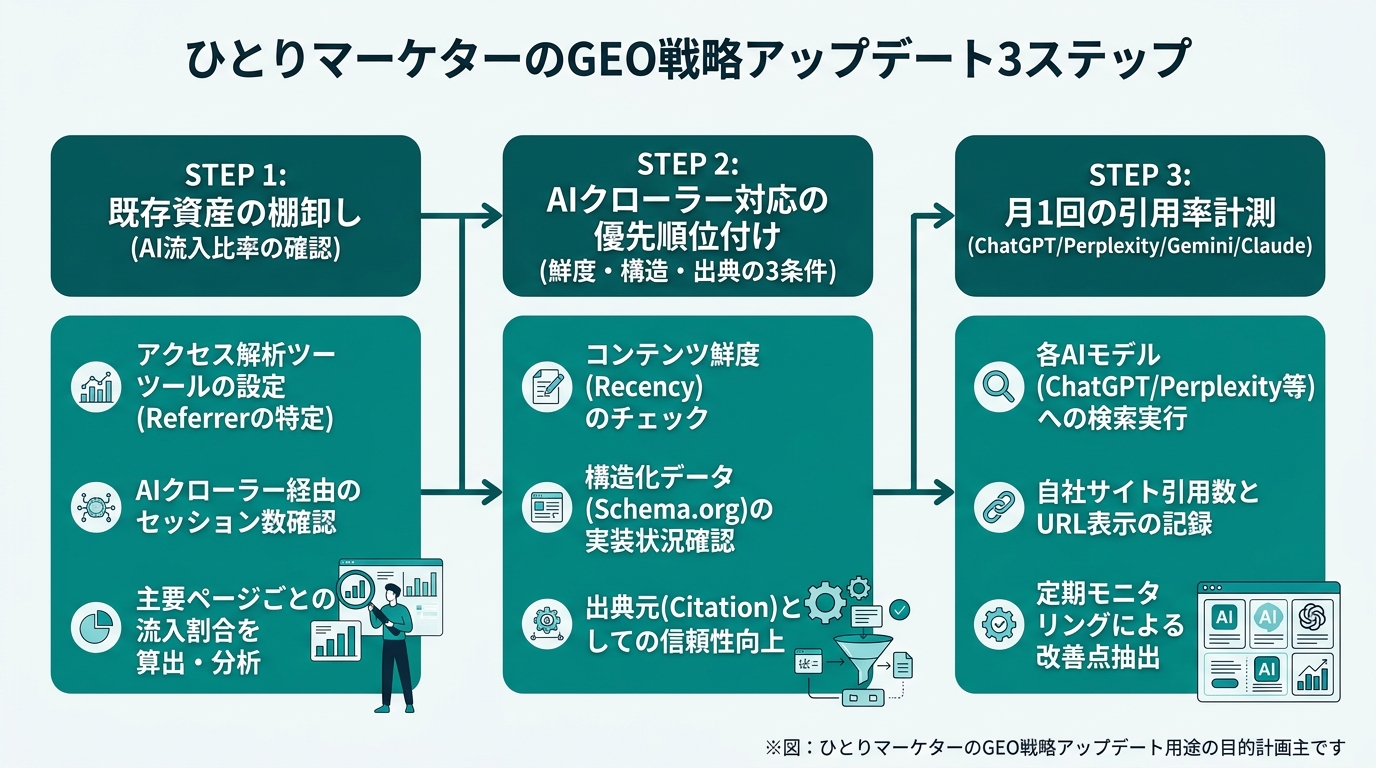
Step 1 is auditing your existing assets. Pull out the top 10 articles by traffic from the past 12 months. Then check the ratio between “articles that draw traffic from Google search alone” and “articles that draw traffic via AI.” Peeking at Perplexity, ChatGPT, and Gemini covers most of the AI side. If the AI ratio is under 10%, that tells you there’s plenty of room left for GEO readiness.
Step 2 is prioritizing AI-crawler readiness. Re-sort the top 10 by three conditions: ① articles with high information freshness (updated within the past six months), ② articles with structures that are easy to summarize, and ③ articles where primary sources are clearly cited. The more an article meets these three conditions, the more likely it is to be cited by AI.
Step 3 is monthly citation-rate measurement. Once a month, ask ChatGPT, Perplexity, Gemini, and Claude about “the major keywords in your industry” and record the rate at which your site is included in their answers. Keep this up for three months and the effectiveness of your initiatives starts to become visible in numbers.
Run this 3-step cycle on a 30-day rhythm and the contours of your GEO strategy should be completely transformed six months later. I’ve covered the GEO fundamentals across Part 1, Part 2, and Part 3 of this series, so if you’re new, starting there will help you pick up the context.
Redesigning the solo marketer’s calendar: weekly and monthly time-allocation example
Putting strategy into words alone won’t change execution. To close, here’s the actual weekly and monthly calendar I’m using as a solo marketer.
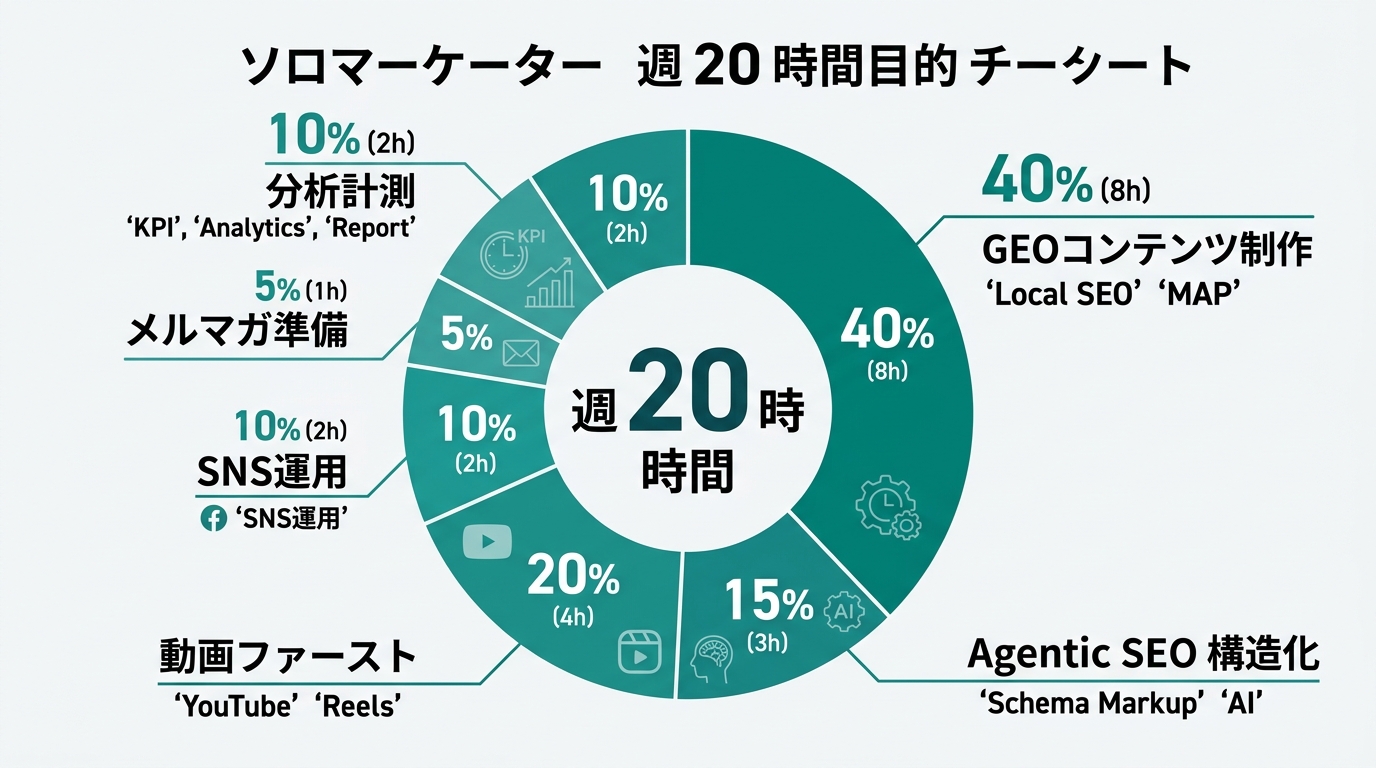
The weekly breakdown (20 hours total) looks like this: 8 hours on GEO content production. 3 hours on Agentic-SEO-related structured-data work. 4 hours on video-first scripting, AI generation, and posting. 2 hours running the two selected SNS platforms. 1 hour on newsletter prep (averaged to a once-a-month cadence). 2 hours on analysis and measurement. 20 hours, covering all 7 areas.
What matters here isn’t what I put in—it’s what I left out. Daily Google rank checks, backlink acquisition, weekly newsletter blasts, running six or more SNS platforms, paid media operations. I cut these completely from this term’s calendar. The time freed up by cutting them is what got rerouted into GEO and video.
On a monthly rhythm, I run: Week 1 GEO citation-rate measurement, Week 2 AI rewrites of top articles, Week 3 concentrated video content production, Week 4 analysis and next-month planning. Locking themes by week reduced decision fatigue and sped up execution.
For example, once I declare “this is video week,” I don’t get yanked off course even if a SNS trend suddenly takes off. Concentrating effort by the week tends to suit solo marketers.
A third tweak: I have a rule that during the last week of every month, I add one initiative to drop. Rather than constantly piling on new things, I force a recurring monthly slot to think about what to release. This has become my biggest preventive measure against long-term burnout.
Wrap-up: 5 actions to decide on Monday morning
I’ve taken SEJ’s 2026 Digital Marketing Top 10 Trends and narrowed them down to “pick up 3, drop 3” through the lens of a solo marketer. Let’s recap.
The three to pick up are GEO (generative AI search optimization), Agentic SEO (AI agent discovery optimization), and video-first × AI video generation. Their common traits: “compounding effects,” “scale that one person can run,” “early-mover advantage still available.”
The three to drop are going for #1 on Google alone, running every SNS platform at once, and email frequency battles. Their common traits: “what was the right answer over the past five years is becoming the wrong answer now,” and “the return on time invested keeps shrinking.”
On Monday morning, decide these five:
- Block out dates on your calendar to rewrite your top 3 existing articles for GEO readiness
- Start setting up structured data for AI agents on a single page
- Pick exactly one AI video generation tool and start the 90-day mastery clock
- Narrow your SNS platforms to two and stop updating the rest
- Switch your newsletter to a monthly cadence and concentrate the density into each issue
Just deciding these five completely rewrites a solo marketer’s calendar for the term. Only the people who skipped trying to grab all ten and instead concentrated on three will be able to look back at this time next year and say “glad I did that.”
I’m planning to publish my own citation-rate report at the start of next month. Try measuring your own site’s AI citation rate once. The lower the result feels compared to expectations, the more headroom you have. Let’s run the 2026 edition of GEO strategy together.

AIを使いこなせない方は、この先どんどん差がつきます。僕はAIエージェントを毎日動かして、壊して、直して、また動かしてます。そういう泥臭い実践の記録をここに書いてます。理論は他の方にお任せしました。僕は動くものを作ります。朝5時に起きてウォーキングしてからコードを書くのがルーティンです。