My AI Tool Bill: $300/Month. The Same Work Done by Humans: Over $80,000/Month. I Translated PrometAI's '1:240' Ratio Into a Way to Read Your Credit Card Statement
For everyone who's ever thought AI tools were expensive. In an era where a $300-$500/month stack replaces an $80K-$120K/month team, here's how to read your expense statement in employment-cost terms
What you'll learn in this article
- The key point to grasp before reading the full article
- How the issue changes practical decisions after reading
- Which follow-up article is worth opening next

My hand froze when I looked at my credit card statement.
Cursor: $20. Claude Max: $100. Zapier: $49. Notion: $18. Canva Pro: $15. Descript: $24. Intercom Fin: $45. Total: $271/month.
“Damn, I’m paying a lot…” was my first reaction.
But then I read PrometAI’s 2026 report and ran the numbers.
“A solopreneur’s AI stack runs $100-$500/month. Maintaining a traditional 5-person team costs over $300,000/year.”
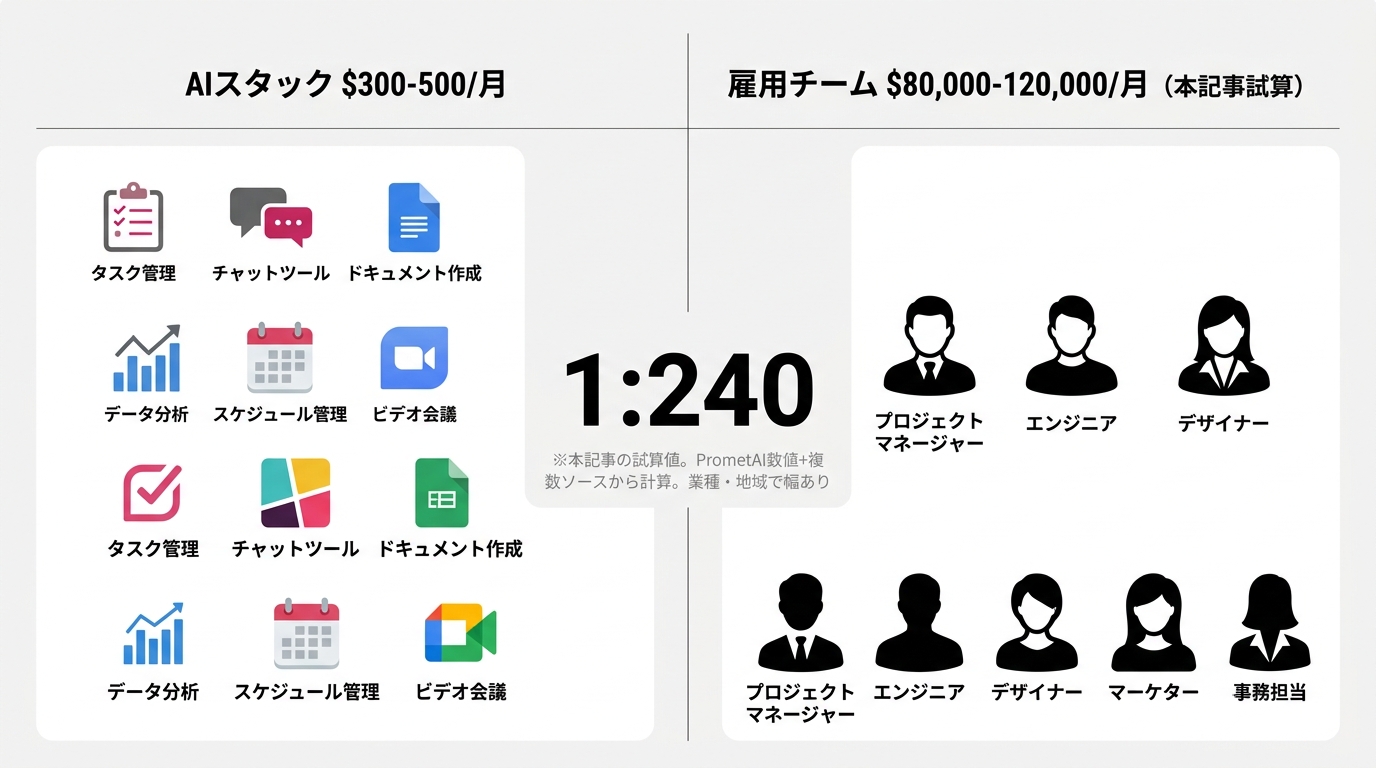
When I added outsourcing and agency costs to this and ran the math, I got a ratio of 1:240.
I’ll show you the full calculation behind “1:240” in the next section. The bottom line first: my $271/month is “basically free” compared to employment costs.
Today’s article is about that “1:240” calculation and how to translate it into business decisions for solo founders and side hustlers. If you’re someone who feels “AI tools are expensive,” this one’s for you. I used to feel the same way, so I’ll lay out exactly how to overwrite that instinct.
PrometAI’s Numbers and the Math Behind My “1:240”
Let me lock down the source. I’m not just speaking from gut feeling.
Here’s what PrometAI’s 2026 piece “The Rise of the Solopreneur Tech Stack in 2026” reports:
“A solopreneur’s AI stack costs $100-$500/month. It covers AI coding, design, content, automation, and customer support.”
“Maintaining a traditional 5-person team costs over $300,000/year.”
(PrometAI: same blog)
Annualized side by side:
- AI stack: $1,200-$6,000/year
- 5-person team payroll: $300,000+/year
The gap: over 95% cut (direct comparison of PrometAI numbers).
Important note here. The “1:240” ratio is NOT calculated by PrometAI — it’s my own estimate in this article.
PrometAI’s “$300K+/year” figure is the floor for a 5-person team’s payroll. Add agency, outsourcing, and VA (virtual assistant) costs to that, and you reach $80,000-$120,000/month. I’ll break down every line item in the next section. The ratio of that total to $271/month is 1:240.
The point of this article is to use 1:240 as a decision-making framework. Don’t memorize the absolute numbers — burn the ratio into your head.
I cross-checked with other sources. GREY Journal (2026) writes that “$3,000-$12,000/year can replace a 5-10 person team.” AI Magicx Blog estimates that “AI agents replace VAs that cost $3,000-$7,000/month per person.” The numbers vary, but the conclusion is consistent: the order of magnitude is different.
Here’s the first insight I want to put into words:
The feeling that “AI tools are expensive” disappears the moment you compare them to employment costs.
Breaking Down the $80K-$120K Team Cost
“Wait, do people really pay $80K-$120K/month?” Some of you might be thinking that.
I thought the same thing at first. So I broke it down by job function.
I read PrometAI’s report, HubSpot’s 2026 marketing budget guide, and intouch-marketing’s small-business marketing team formation guide side by side, and this picture emerged:
- Marketing Manager (annual $80K-$120K) = $6,700-$10,000/month
- Copywriter (annual $60K-$90K) = $5,000-$7,500/month
- Graphic Designer (annual $55K-$85K) = $4,600-$7,000/month
- 2 Customer Support staff (combined annual $80K-$110K) = $6,700-$9,200/month
- Accounting/Operations (annual $70K-$95K) = $5,800-$7,900/month
That alone totals $28,800-$41,600/month.
On top of that, you pay insurance, taxes, benefits, office, and training costs. By US standards, “1.25-1.4x salary” is the actual employment cost. Homebase’s 2026 employment cost guide says the same thing.
Recalculating at a rough 1.3x: $37,440-$54,080/month.
“Hmm, that’s still not $80K?”
That’s the catch. PrometAI’s “$300K+/year” assumes a level above this. Specifically:
- Marketing agency contracts ($5,000-$15,000/month, WebFX 2026 data)
- Development outsourcing ($10,000-$30,000/month, Morph 2026 AI coding cost analysis)
- Branding/PR firm ($5,000-$20,000/month)
- 2-3 virtual assistants ($6,000-$15,000/month)
- Existing employee payroll ($28K-$41K/month from above)
Add it all up: $54,000-$121,000/month. This lands in this article’s estimated “$80K-$120K” range.
So “team cost $80K-$120K” means “total operating cost of full-time employees + outsourcing + agencies.” It’s the total infrastructure you’d need to run a company solo, without AI.
Here’s how I read it:
What the “AI stack” replaces isn’t one employee. It’s “the entire operating team — full-time staff plus outsourced contractors plus agencies, all moving as one unit.”
Misunderstand this and you’ll say, “No way $300/month of AI does $80K of work.” Of course not. What’s being replaced isn’t “an $80K/month individual” — it’s “the $80K/month organizational function.” Without shifting your perspective, the meaning of 1:240 won’t land.
The Full $300-$500/Month Stack — Showing You Everything
Now let me break down what you can actually buy for $300-$500/month.
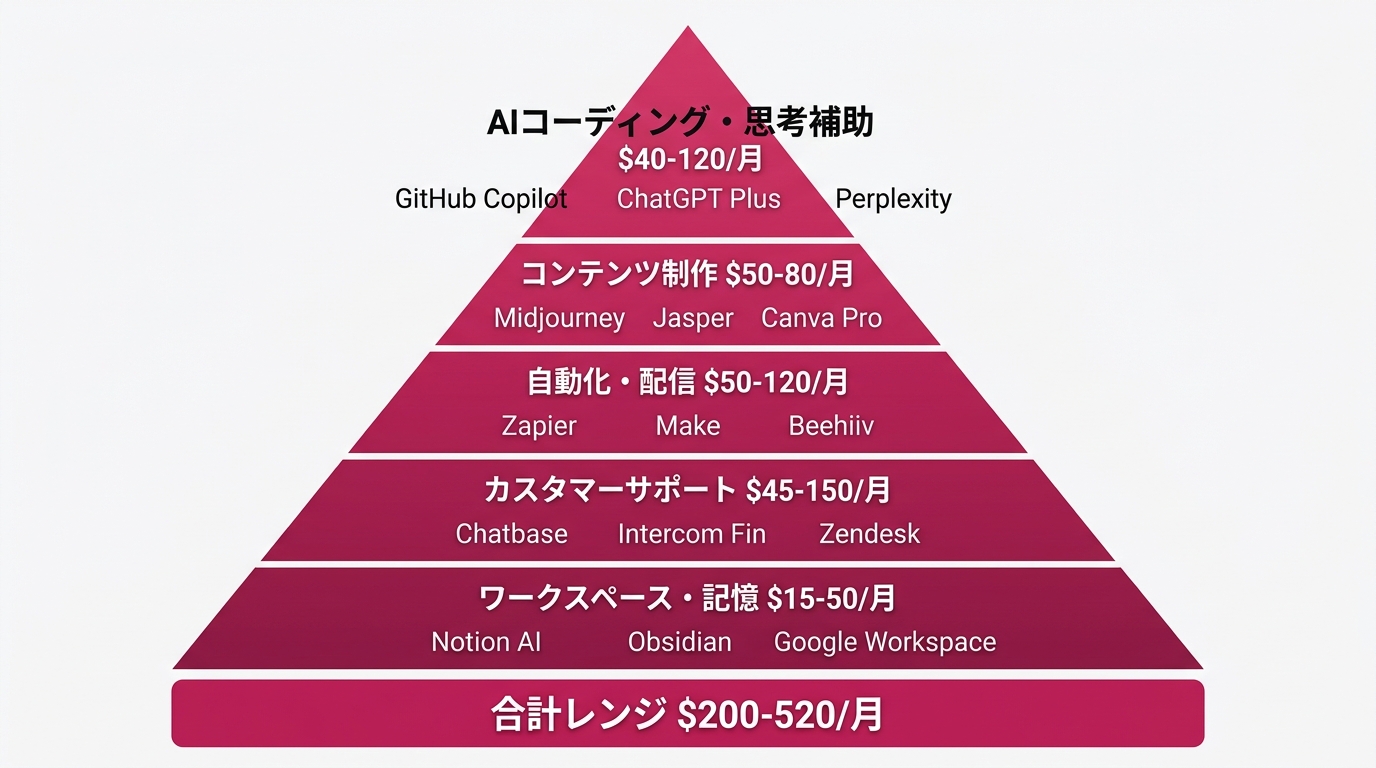
Based on PrometAI’s report and DEV Community’s 2026 AI stack guide, I organized this into 5 pillars. This is the typical full-stack contents (plan names and prices as of April 2026).
Pillar 1: AI Coding & Thinking Support ($40-$120/month)
- Cursor Pro: $20/month (code editor, VS Code compatible)
- Claude Pro: $20/month (Anthropic’s chat plan)
- Claude Max 5x: at $100/month, you can hammer the Opus-level reasoning engine
Lock this in and you can run development, analysis, and ideation solo. With Claude Code, you can automate file generation, testing, and commits inside your terminal (Claude official pricing).
Pillar 2: Content Production ($50-$80/month)
- Descript: $24/month (video/audio editing)
- Canva Pro: $15/month (design)
- Opus Clip: $19/month (extracting short videos from long-form content)
Enough to maintain daily updates across YouTube, Instagram, TikTok, and LinkedIn solo.
Pillar 3: Automation & Distribution ($50-$120/month)
- Zapier: $30-$50/month (5,000+ SaaS integrations)
- Make (formerly Integromat): $20-$30/month
- n8n (self-hosted): $0-$50/month
Run “task triggers → AI processes → return notification” unattended.
Pillar 4: Customer Support ($45-$150/month)
- Intercom Fin: from $45/month (AI agent type)
- HelpScout: from $25/month
- Crisp: from $25/month
24/7 automated responses. With knowledge base integration, you can handle 80% of FAQs without human hands.
Pillar 5: Workspace & Memory ($15-$50/month)
- Notion: $18/month (project management + AI assist)
- Taskade Genesis: $20-$30/month
- Airtable: $20-$24/month
The team’s memory keeper. AI summarizes meeting notes and hands tasks off to the next assignee (= you).
Total: $200-$300/month minimum, $400-$500/month full setup. Lands within PrometAI’s “$100-$500” range.
One important point here. I’m not saying “install everything.” As I wrote in my earlier piece “5 Tools Are Enough,” narrowing down to 5 tools works better. I listed the full stack to show you “the upper-limit map.” The right approach is to “build up from the floor.”
The “Expense Statement Re-Read” Exercise — Rewriting Your Credit Card Statement in Employment-Cost Terms
Here’s the core of this article. Just memorizing “the 1:240 ratio” won’t change behavior. We need to add the concrete work of re-reading your expense statement.
Three steps.
Step 1: List every AI tool subscription from the past month
Open your credit card statement and pull out all AI-related subscriptions. For me:
| Tool | Monthly Fee |
|---|---|
| Cursor | $20 |
| Claude Max | $100 |
| Zapier | $49 |
| Notion | $18 |
| Canva | $15 |
| Descript | $24 |
| Intercom Fin | $45 |
| Total | $271 |
In JPY (at 150 yen/$), about 40,000 yen.
Step 2: Write down what job function each tool replaces
This is the translation step.
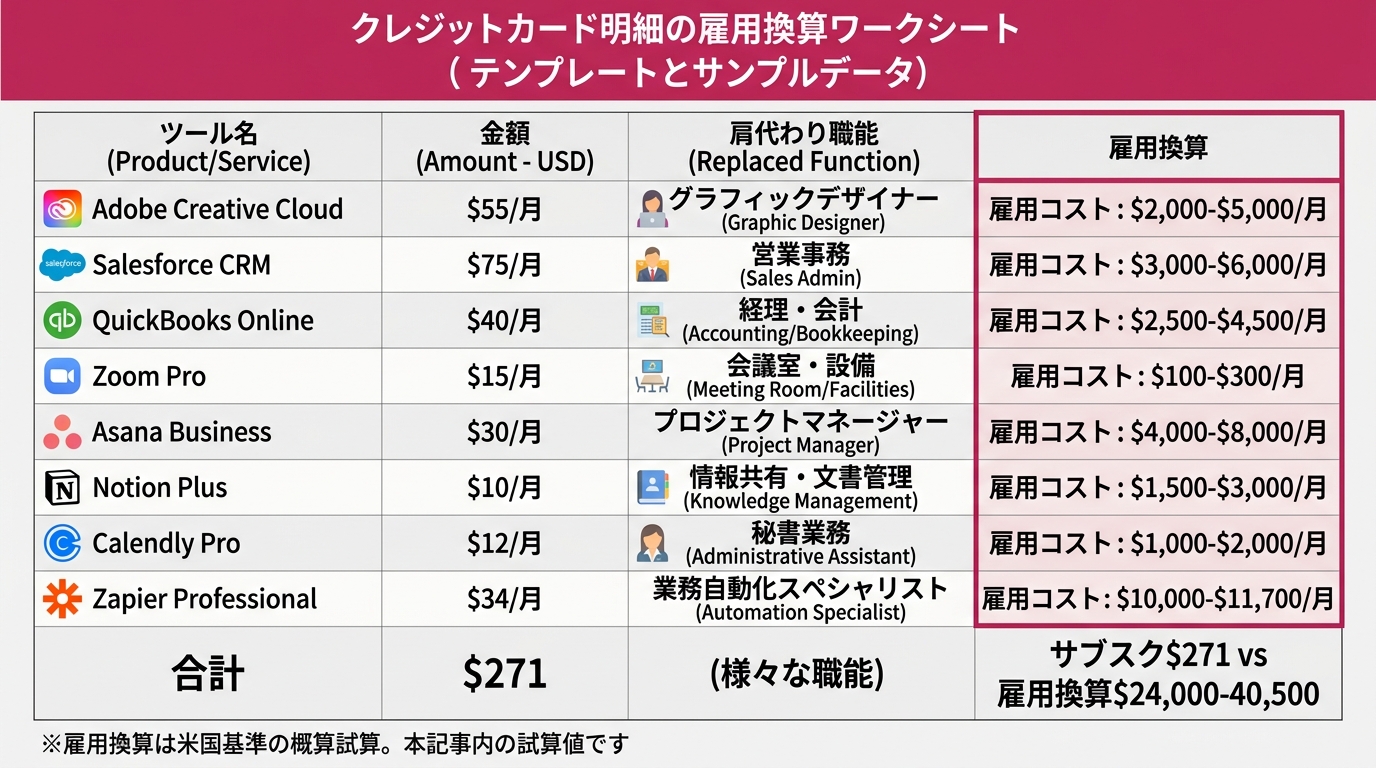
| Tool | Job Function Replaced | Employment-Equivalent Monthly Cost (US standards) |
|---|---|---|
| Cursor + Claude Max | Junior engineer + analyst | $8,000-$12,000 |
| Zapier | Systems operations | $4,000-$7,000 |
| Notion | Project manager (partial) | $3,000-$5,000 |
| Canva | Graphic designer (part-time) | $2,500-$4,000 |
| Descript | Video editor (part-time) | $2,500-$4,500 |
| Intercom Fin | 1-2 customer support staff | $4,000-$8,000 |
| Total (employment equivalent) | $24,000-$40,500 |
My $271/month subscription portfolio carries $24,000-$40,500/month worth of function in employment terms.
“$271 / $24,000 = 1.1%” “$271 / $40,500 = 0.67%.”
I’m running equivalent function for less than 1% of employment cost.
Step 3: Decide what to cut and what to add
Here’s a common failure — one I’ve made too:
“It’s cheap, let’s add it.” “Everyone’s using it, let’s add it.”
That’s how you end up with 10-20 tools. When you write out the “replaced job function” in Step 2, you start to see overlapping functions.
In my case, I once had Cursor, GitHub Copilot, and Claude Code all running at the same time. All three overlapping on “code generation.” Just narrowing $60/month to one $20 tool freed up $480/year. Justin Welsh’s philosophy of “keeping operating costs under 1% of revenue” starts here. He publishes on his blog how he runs $5M with a simple stack.
You also see “functions that aren’t being covered.” For me, lead generation (sales) was missing. So I added Apollo at $30/month. For $30/month, I started moving work that would cost $3,000-$5,000/month to outsource.
Do this exercise “once a quarter.” Rewrite your credit card statement in different terms. That alone overwrites the feeling from “subscription-poor” to “operator running at <1% of employment cost.”
3 Traps Where 1:240 Breaks Down — Why Some People Don’t Get Results From AI
“OK, I get the ratio, but does it really replace things that easily?” That question is fair.
Honestly: 1:240 doesn’t always work. I’ve fallen into this myself. Three traps to share.
Trap 1: “Just install the tool” without designing operations
You signed up for Cursor. Added Claude Max. Brought in Zapier. But you haven’t decided “what to delegate to this tool” or “where humans look in.” The tools run, but the business doesn’t. You pay $300/month and get zero results.
The fix is writing a “role definition document.” One page per tool. Spell out “what this tool handles,” “what it doesn’t,” and “how often humans verify.” I keep a Notion page called “AI Stack Operations Notes” and add a role definition every time I add a tool.
Trap 2: Going “100% AI, zero humans”
This is also dangerous. As AI Magicx’s 2026 report points out, “hybrid” is the realistic answer (AI Magicx Blog). AI agents handle 80%, humans handle the remaining 20%. That 20% is relationship-building, final judgment calls, and physical-world tasks. The 2026 standard answer is to cover this with a part-time VA at $800-$1,500/month.
If you aim for 100% automation, the cost of fixing judgment errors will exceed what you saved. Set “80% automation + 20% human” as your target. This is the structure Justin Welsh uses even at $5M scale (Starter Story).
Trap 3: “Evaluating before using”
I’ve seen tons of people stop at Claude Pro $20 thinking “Claude Max at $100? Too expensive…” If you only do “thinking sparring” on Pro $20 and don’t upgrade to Max, you can’t run “analysis, code generation, long-context processing.”
The iron rule is “use it, then judge by the results.” Run it on Max for the first month, fall back to Pro if it doesn’t pay back. That’s the “investment recovery cycle.”
In a previous article, The Day a $75/Month AI Stack Beat a $1,000/Month Assistant, I wrote that AI tool costs aren’t “sunk costs” — they’re “fuses to monetization.” Invest with the premise that you’ll fully exploit it for one month.

Redesigning Next Month’s Credit Card Statement — Action Checklist
For everyone who read this far, here are 5 actions to take before next month.
1. List every AI tool subscription from the past month (30 min)
Open your credit card statement, PayPal history, or subscription manager (like Truebill) and pull out every AI-related subscription.
2. Write out the “replaced function” for each tool (30 min)
Write “if this tool disappeared, what work would happen instead.” Things like “copywriter $5,000/month” or “VA $3,000/month.” US-standard salaries are searchable on Glassdoor by job title.
3. Narrow overlapping functions to one (15 min)
If “code generation” is split across 3 tools, narrow to the one you use most. You’ll free up $30-$80/month.
4. Add one missing function (30 min)
Lead generation, accounting, or customer success — if any of these would cost $2,000-$5,000/month to outsource, try one $30-$50/month AI tool. As a one-month-limited investment.
5. Repeat the exercise quarterly
This works the most. Look at your statement again 3 months later. The “tools you’re not using” and “tools you should add” will always have shifted.
From my experience, repeating this exercise 2-3 times completely changes how you feel about subscriptions. You stop thinking “expensive vs. cheap” and start thinking “what % can I recover in employment terms.” That’s the operating instinct of a solopreneur.
For reference, Pieter Levels (Levelsio) runs a $3M/year business with zero employees. Justin Welsh runs over $5M with “operating costs under 1% of revenue.” What they’re doing isn’t special. They’re “re-reading 1:240 every month.” That’s it.
Conclusion — Overwriting “Subscription-Poor” With “Operator Running at <1% of Employment Cost”
The whole story in 3 lines:
- An AI stack at $300-$500/month can replace operating costs of $80K-$120K/month including outsourcing and agencies (this article’s estimate. Base: PrometAI 2026, supplements: HubSpot/WebFX/Homebase). The ratio is 1:240.
- Re-reading your credit card statement in “employment-equivalent terms” reveals that you’re operating at less than 1% of employment cost.
- Redesign your statement once a quarter. Make “delete overlap + cover gaps” a habit.
Back to the start.
My credit card statement: $271/month. This isn’t “subscription-poor.” It’s the statement of an “operator” running $24,000-$40,500/month of function at less than 1% cost.
Looking at the same fact, changing the frame changes the meaning. “Expensive” gets overwritten with “basically free.” “Cost” flips to “investment.” “Tools” get re-read as “organizational functions.”
The reason solopreneurs can win in 2026 isn’t because AI is cheap. It’s because only “people who can read the ratio” can act in this era.
I used to think “subscriptions are a luxury” back in my employee days. After going independent, I realized “subscriptions are employment substitutes.” The moment I realized that, paying $300/month started looking like “savings.”
Try rewriting next month’s credit card statement in employment-equivalent terms. Your world will change.
Don’t waste time hesitating — open the statement. It takes 30 minutes. I went first and left you the format.
Related Articles:
- The Day a $75/Month AI Stack Beat a $1,000/Month Assistant — The cost-effectiveness premise
- 5 Tools Are Enough. The $87/Month Solopreneur AI Stack That Just Works / Practical narrowing-down
- Polsia $4.5M, Medvi $400M, Levelsio $3M: 5 Unicorn Realization Cases — Predecessors who realized 1:240
- Chinese Cities Are Stacking $1.4M Subsidies to Compete for Solo AI Founders — National policy vs. self-driven contrast
Sources:
- PrometAI: The Rise of the Solopreneur Tech Stack in 2026
- GREY Journal: Solo Founders Million-Dollar AI Businesses 2026
- AI Magicx Blog: AI Agents Replace Virtual Assistant Solopreneur 2026
- Anthropic Claude Pricing
- WebFX: Marketing Agency Cost 2026
- Starter Story: Justin Welsh
- Starter Story: Pieter Levels Nomad List Breakdown
- Justin Welsh Newsletter

女性だからこそ、AIを使いこなさなきゃって思ってる。仕事も、副業も、推し活も、旅行も、全部やりたい。人生一度きりなのに時間は足りないじゃん?だからAIに任せられることは全部任せる。浮いた時間で本当にやりたいことをやる。それがあたしのスタイル。ここにはあたしが実際にやったことをまとめてるだけ。誰かのためになったらいいなって思って書いてるよ。