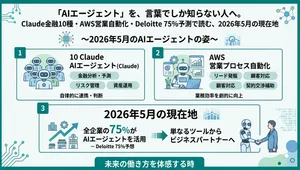
"AI Will Take Your Job" Is the Wrong Question. Reading BCG, Deloitte, and IMF's Latest Data: The 2026 Skills Swap War and 3 Things to Do This Week
92 million jobs will disappear, 170 million new ones will emerge. Reading five major studies reveals not a 'fear of losing jobs' but the 'reality of swapping skills.' Three actions you can start this week, backed by data.
What you'll learn in this article
- The key point to grasp before reading the full article
- How the issue changes practical decisions after reading
- Which follow-up article is worth opening next
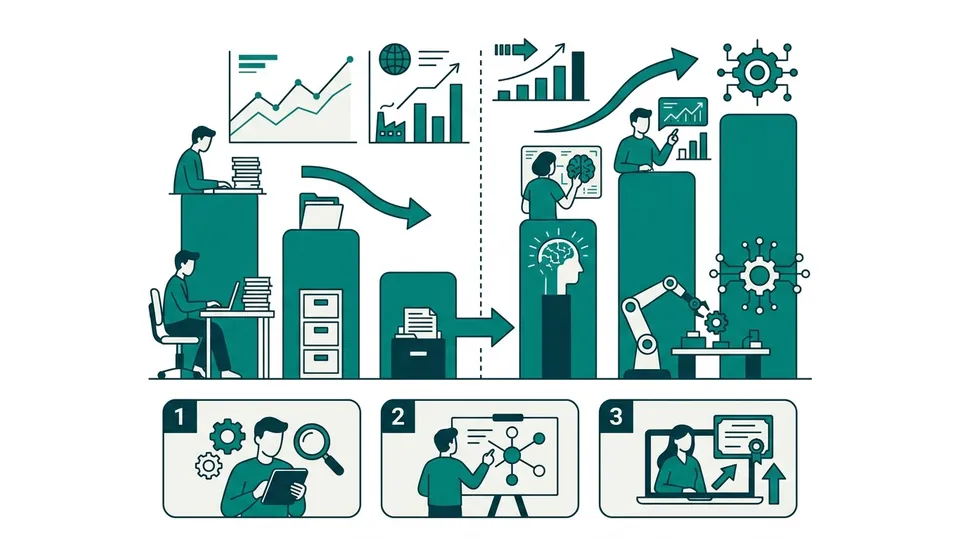
“AI might take my job.” Do you still carry this anxiety?
It’s natural if you do. I felt the same way at first. There was a period when every news headline made me think, “Am I next?” But when I lined up five datasets — from BCG, Deloitte, IMF, and Gallup (all released in 2026), plus WEF’s February 2026 summary of the 2025 Future of Jobs Report — and read them side by side, the picture I saw was completely different.
Yes, some jobs will disappear. That’s a fact. But nearly twice as many new jobs will emerge. The real question isn’t “Will my job disappear?” but “Will my skills remain relevant?”
This article distills the changes happening in 2026 from five sources: BCG (Boston Consulting Group), Deloitte, IMF (International Monetary Fund), WEF (World Economic Forum), and Gallup. It’s structured so that by the time you finish reading, you can decide what to do this week.
BCG’s Conclusion: “AI Won’t Replace Jobs, It Will Reshape Them”
AI doesn’t “take” jobs — it “remakes” them. This is the single biggest fact emerging from 2026’s global data.
The title of BCG’s 2026 report captures it succinctly: “AI Will Reshape More Jobs Than It Replaces.” More jobs will be reshaped than replaced.
The report also states: “Over the next 4–5 years, 10–15% of U.S. jobs could disappear, while 50–55% will be reshaped.” Yes, some jobs will vanish. But far more jobs will be transformed in shape, according to BCG’s outlook.
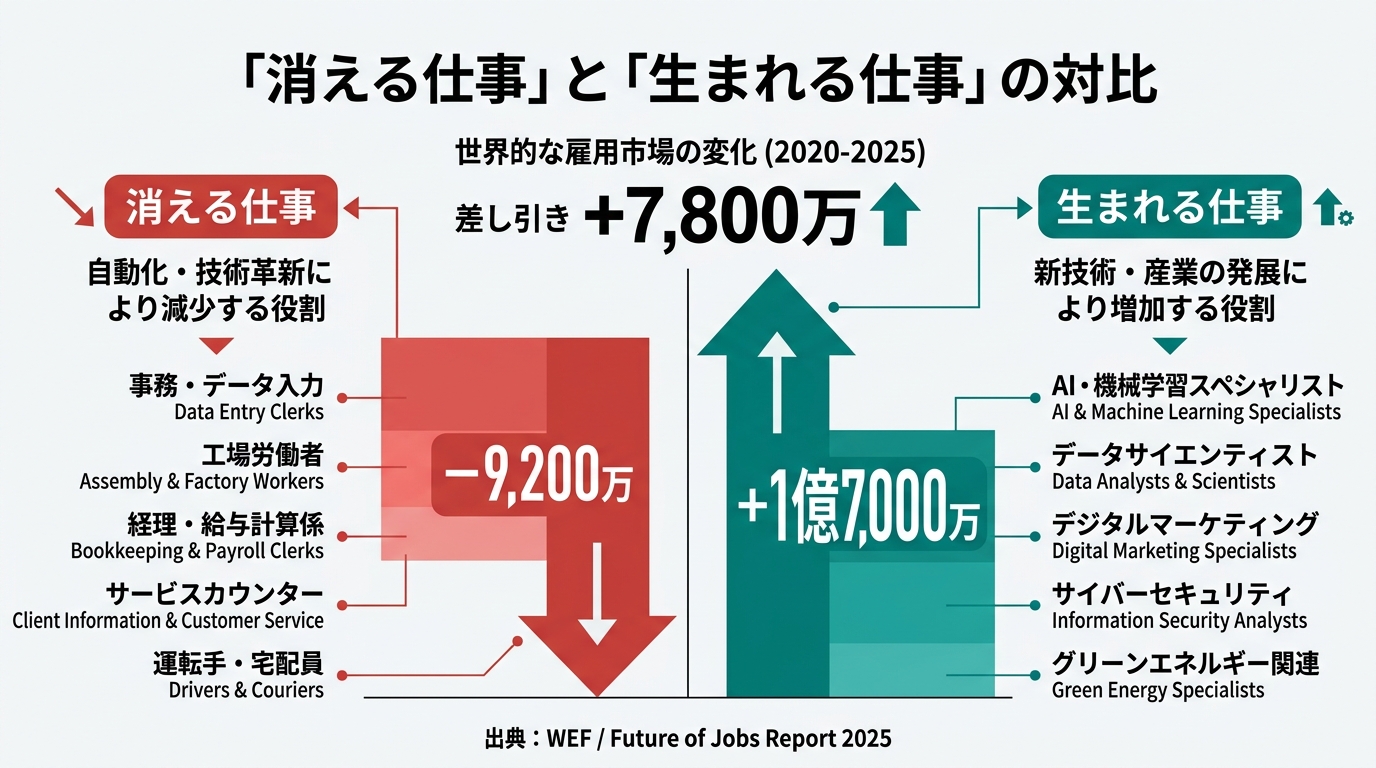
Let’s look at the numbers. According to a WEF analysis published in February 2026, drawing on the 2025 Future of Jobs Report, about 92 million jobs are expected to disappear by 2030. Seeing only that figure, anyone would feel uneasy.
But the same data carries another number: about 170 million new jobs will emerge in the same period. That’s a net gain of roughly 78 million. Far more jobs are being created than destroyed.
“But what if my job is on the disappearing side?” That’s a natural reaction.
This is where the word BCG uses — “reshape” — matters. What disappears isn’t “jobs” but “specific tasks within jobs.” For example, accountants won’t disappear, but the “data entry” and “routine report generation” tasks they perform will shift to AI. What remains: judgment calls on anomalies, strategic advice to executives, negotiations with vendors — the kind of judgment and dialogue only humans can deliver.
I’ve experienced this “reshaping” firsthand in marketing. I used to spend three hours drafting proposals. Now I let Claude write the first draft and lock in the structure in 30 minutes. The 2.5 hours I save go into client conversations and designing new campaigns. The job didn’t disappear. The contents got swapped.
I call this “contents swap” the Skills Swap War.
Skills that used to be valuable get obsolete, and different skills become essential. The battlefield is the same. The weapons changed. Whether you recognize this or not will dramatically shape your career from 2026 onward.
88% Adoption, 25% Execution: Deloitte Exposes the “Going Through the Motions” Crowd
While enterprise AI adoption has hit 88%, only a quarter of companies are seeing real results.
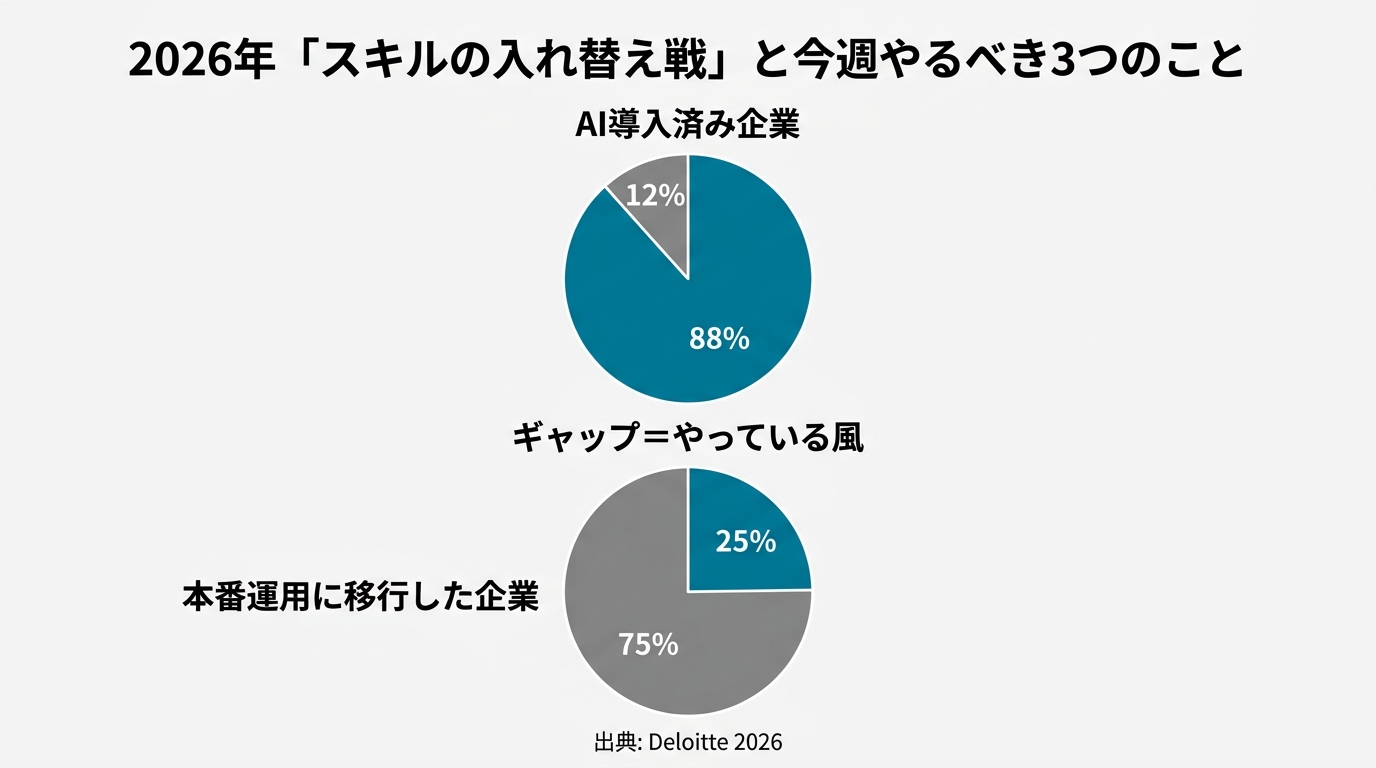
Deloitte’s “State of AI in the Enterprise 2026” lays out this reality in numbers. According to Deloitte, 88% of organizations have deployed AI somewhere in their operations.
Yet only 25% of companies have successfully moved more than 40% of their AI pilots into production. Three out of four organizations are stuck at “we tried it once.”
Translated to the individual level, the numbers get even more interesting.
According to Deloitte, companies expanded employee access to AI tools by 50% over the past year — from under 40% to about 60%. In other words, six out of ten employees now have access to AI tools.
But of those with access, fewer than 60% actually use AI in their daily work. More than 40% have access but don’t use it.
The reason this “access without use” gap exists is clear: people don’t know what to use it for. They get the tool but no design for where in their workflow it fits. This isn’t individual laziness — it’s organizational design failure.
Gallup’s research provides supporting data. Among employees at organizations that have adopted AI, 18% say “my job could disappear due to AI within 5 years.” Yet 65% at the same organizations report “AI has improved my productivity.”
Anxiety and effectiveness coexist. This is the real face of the 2026 workplace.
The question becomes: what separates the 25% that’s getting results from the 75% just going through the motions? From what I’ve observed, the answer is simple: whether they’ve explicitly documented which tasks use AI. “You’re free to use it” doesn’t stick. Only organizations that specify concrete tasks — “weekly report drafts are AI-generated,” “customer email reply drafts go to AI first” — move from the 75% side to the 25% side.
The “Phase 2” argument I made yesterday in “Just ‘Using AI’ No Longer Creates Differentiation” aligns perfectly with Deloitte’s data. Adoption is sufficiently advanced. The next battle is designing execution.
39% of Skills Will Be Obsolete by 2030: Inside the Swap War
About 40% of the skills you have now will be useless in four years. IMF and WEF data drive home this harsh reality.
The IMF’s January 2026 report, titled “New Skills and AI Are Reshaping the Future of Work,” reports that the skill turnover is accelerating. One in ten job postings in developed countries — and one in twenty in emerging markets — already lists “new skills” as a requirement.
WEF’s 2025 Future of Jobs Report goes further: 39% of current work skills will be obsolete by 2030. Not all 40% will become unusable, but they alone won’t be enough.
To grasp the impact of “39%,” try writing down ten of your own skills. Four of them will be either “table stakes” or “irrelevant” four years from now. Can you compete with just the remaining six?
So what are the “replacement” skills? Overlaying the IMF and WEF reports reveals two categories.
Category 1: Digital and technical skills. AI literacy, data analysis, automation design, cybersecurity, cloud operations. Among these, “AI literacy” is already being treated as a “foundational skill across all job functions” as of 2026. This isn’t just about programmers. Sales, HR, accounting — every role needs the ability to understand how an AI model is making decisions, what data it’s using, and how to interpret its outputs.
Category 2: Human and adaptive skills. Creativity, empathy, communication, resilience, leadership. As the flip side of what AI excels at — pattern recognition, data processing, routine generation — the things AI struggles with — building trust between humans, adapting to unpredictable situations, interpreting meaning — are actually rising in value.
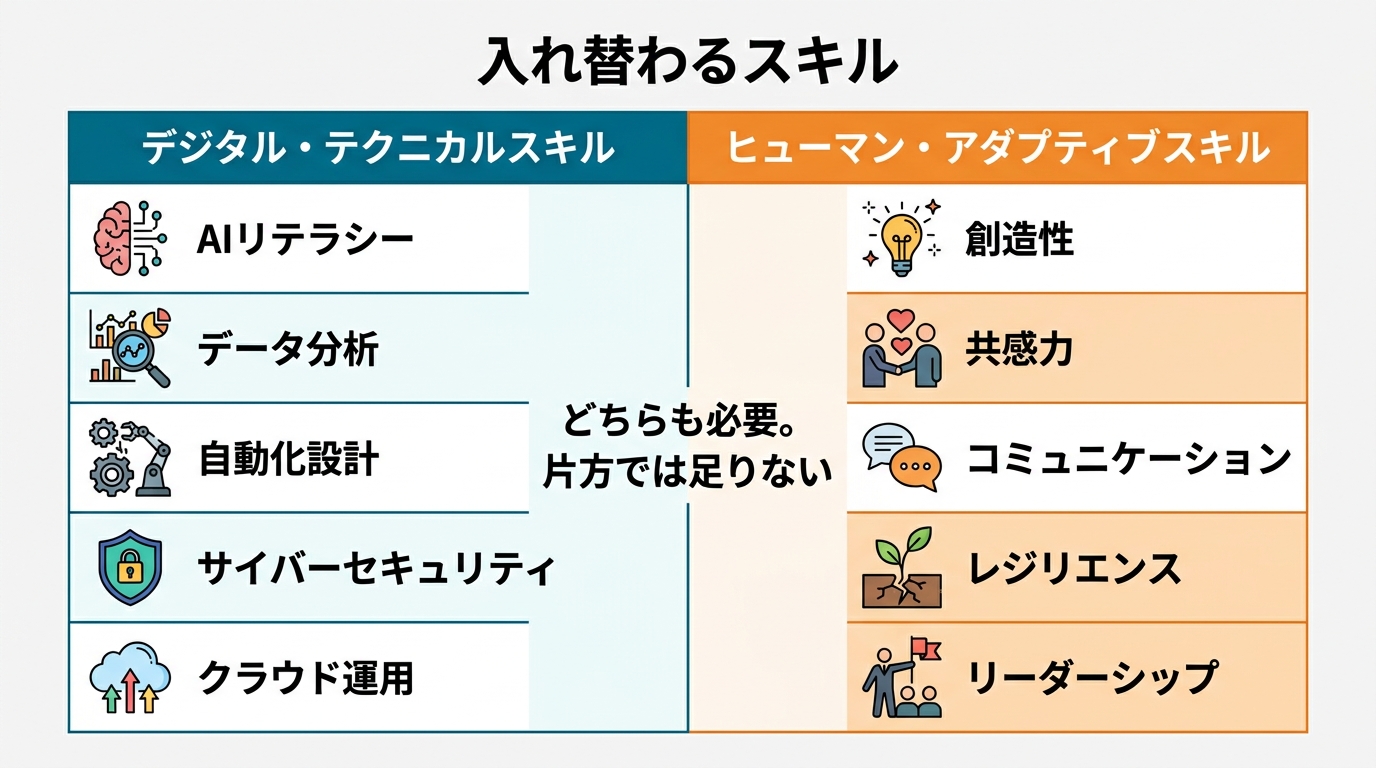
The combination of these two categories matters. AI literacy alone won’t carry you if you can’t build trust with people. Conversely, if you have great communication skills but can’t use AI tools, you’ll lose ground in productivity.
“Using AI” and “honing your human strengths” aren’t an either/or. Running both at once is the right way to fight the Skills Swap War.
One example from my own experience. Back in my marketing days, I taught teammates how to use AI tools. The fastest learners weren’t the tech-savvy ones. They were the ones “who knew our customers’ problems best.” They knew exactly what to ask the AI. As a result, their prompts were sharp from day one. I watched technical and human skills multiply each other in real time.
Agentic AI: 74% of Companies Will Adopt It Within 2 Years
AI agent adoption has moved from “experimentation” into the “standard equipment” phase.
The same Deloitte report reveals another important number. Companies that use agentic AI (autonomous AI that executes tasks without human instruction) “at least moderately” stand at 23% today. Still a minority.
But the share planning to use it “at least moderately” within two years jumps to 74%. More than two out of three companies plan to integrate AI agents into their operations by 2028.
This aligns with Gartner’s prediction too: by the end of 2026, 40% of enterprise apps will feature task-specific AI agents. That’s an 8x jump in a single year from less than 5% in 2025. I covered this in detail in “40% of Enterprise Apps Will Have AI Agents Built In”.
When you hear “AI agents,” you might assume this is just a programmer’s concern. It isn’t.
Take sales. An agent that automatically gathers prospect intel, cross-references past deal history, and generates a “list of who to approach this week” every morning. HR. An agent that screens applicant resumes and auto-coordinates interviewer schedules. Marketing. An agent that analyzes A/B test results from social posts and auto-suggests the next campaign content.
None of these require writing code. What they require is the ability to design which parts of your workflow you hand off to AI. This is the concrete substance of what I called “AI literacy” earlier — the centerpiece of the Skills Swap War.
I run my own content production inside an AI agent system called Izumo. Article research, competitive analysis, quality checks, image directive design — multiple agents divide and execute the work. At first I thought “it’d be faster if I did it all myself.” Once I actually delegated, quality improved and I could focus on the judgment call of “what to write.”
The wave of AI agents is shifting from “something engineers prepare” to “something everyone needs to decide how to engage with.” Saying “we’re still evaluating it” two years from now will likely be too late.
Three Things to Do This Week: A Data-Backed Minimum Action Plan
From five global studies, I’ve narrowed down to three things individuals should do right now.
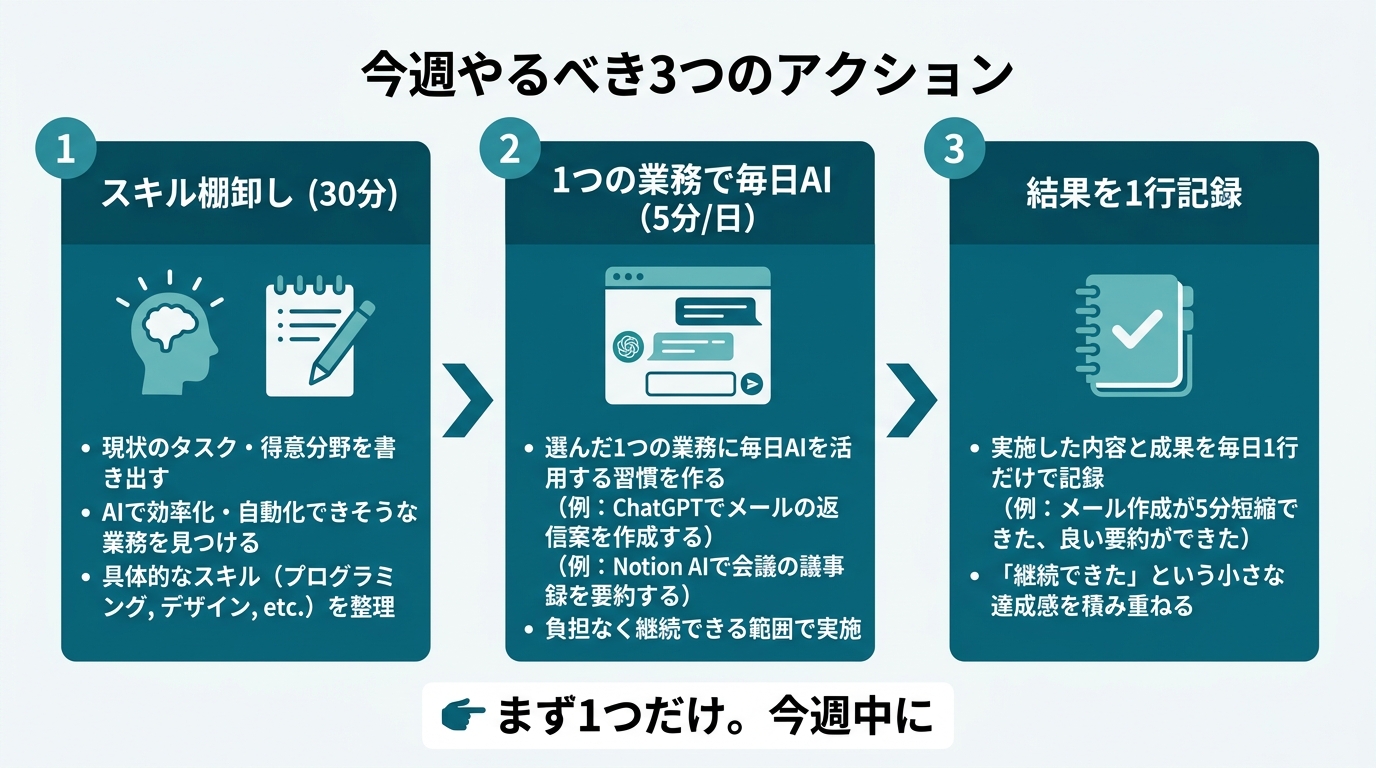
When you organize all the data we’ve covered, individual-level actions converge to three. You don’t need to do them all at once. Just start one this week.
Action 1: Write down ten of your skills, then tag each with its “AI replacement risk.”
This applies WEF’s “39% obsolescence” to yourself. Paper or spreadsheet — either works. List your top ten skills, then tag each with how replaceable AI makes it: A (high), B (partial), C (low).
If you have four or more A’s, you’re a participant in the Swap War. If you’re heavy on B’s, designing “coexistence with AI” is your key. If C’s dominate, the right strategy is to deepen your current skills while adding AI literacy.
Thirty minutes is enough for this inventory. Thirty minutes will give you a clear direction for where to invest.
Action 2: Create a daily AI routine for one specific task.
As Deloitte’s data showed, more than 40% of people with AI access don’t use it. The reason: they haven’t decided what to use it for. The flip side: just decide on one thing, and you can start.
For example. Have AI summarize industry news each morning. Generate a draft of your weekly report with AI before editing. Let AI draft email replies, and you only adjust the tone. Each one can start in five minutes.
The key is doing it every day. Once a week won’t form a habit. Gallup’s research shows the people who feel “more productive thanks to AI” tend to be daily users (my own observations match this pattern). Frequency creates retention. Retention creates results.
Action 3: Log “what you delegated to AI” — even just one line.
“Today, had AI draft my email reply. Time: 5 min → 2 min. But tone was too stiff so I edited it.” That’s enough.
Why does logging matter? Because the gap between Deloitte’s “88% adoption” and “25% execution” comes down to whether companies measure effects. Without records, it stays at “feels useful.” With records, you can see “how many hours I saved per month” and “where it’s strong vs. weak.”
A month of records becomes ammunition to report “concrete AI ROI” to your boss or executives. It turns your personal experience into a weapon for organizational investment decisions.
Where Are You on the AI × Work Skills Map? Four Types
Honestly identifying where you stand right now is the first move in the Swap War.
Based on all the data above, I’ve classified individual AI × work skills into four types. Check which one you are.
Type A “Untouched”: Haven’t used AI tools at work yet. You know the names but haven’t tried them.
→ First, just open one tool. ChatGPT or Claude — either is fine. Type “summarize today’s events in three lines.” That’s all. Once you touch it, you’ll get a feel for what’s possible. WEF’s claim that “AI literacy is foundational for all jobs” only makes sense when you’ve felt it.
Type B “Occasional user”: You use AI a few times a week. Sometimes you find it useful, but you could get work done without it.
→ You’re in Deloitte’s “less than 60% daily user” zone. The way out: fix one task you do with AI every day. Going from three times a week to daily changes how you use AI. The pivot point of growth is when “I could survive without it” turns into “it’d be slow without it.”
Type C “Daily user”: You use AI every day. For specific tasks, AI-first workflows are running. But you haven’t expanded to other tasks or to teammates.
→ The next step is horizontal expansion. Teach one teammate the AI workflow you’ve established. Teaching deepens your own understanding. ARI deploying Claude Code company-wide (details here) is exactly this “horizontal expansion” at organizational scale.
Type D “Designer”: You design and operate automation workflows including AI agents. Measurement and improvement cycles are running.
→ You’re already on the winning side of the Swap War. Your next challenge is consciously honing the strengths AI can’t replace. The essence of BCG’s “reshape” is the optimal allocation between what AI handles and what humans handle. Your technical skills are sufficient. Invest your time in human skills — especially the ability to move people and judgment in unpredictable situations.
To be honest, I think I’m somewhere between Type C and D right now. My AI-agent-powered content production is running. But if you asked me whether I’m consciously sharpening the areas AI can’t handle, I’d say not enough. Let’s grow together.
Conclusion: The Winners of the Swap War Are Those Who Keep Learning
In 2026, when talking about the relationship between AI and work, “stolen” is no longer accurate.
BCG says “reshape.” WEF shows “more jobs created than destroyed.” Deloitte points out that “adoption has advanced but execution hasn’t caught up.” IMF warns that “skill replacement is accelerating.” Gallup reports that “anxiety and effectiveness coexist.”
The future painted in common across these five reports looks like this:
- Jobs don’t disappear. Their contents change. 92 million jobs disappear, 170 million new jobs emerge. Net positive. What you should fear isn’t “losing your job” but “your skills becoming obsolete.”
- Adoption alone no longer creates differentiation. With 88% adopted, the contest is now about designing execution. Whether you can join the 25% execution layer is the dividing line.
- You need both technical and human skills. AI literacy alone isn’t enough. Communication alone isn’t enough. The strongest people run both wheels at once.
The Skills Swap War has already begun. What decides the outcome isn’t AI’s performance — it’s whether you keep learning.
This week, just one of the three actions is enough. “Skill inventory,” “daily AI on one task,” or “one-line record of results.” Pick one and start.
AI is a tool. The question isn’t whether you have the tool but whether you can wield it to evolve yourself. That, I believe, is the most important question of 2026. Let’s tackle it together.
References
- BCG “AI Will Reshape More Jobs Than It Replaces” (2026) — Analysis that AI “reshapes” rather than “replaces” jobs
- Deloitte “State of AI in the Enterprise 2026” — 88% AI adoption, 25% production deployment, agentic AI trends
- IMF “New Skills and AI Are Reshaping the Future of Work” (January 2026) — How AI is shifting skill demand
- WEF “Workforce Transformation AI Jobs” (February 2026 summary) — 92M jobs lost / 170M created forecast and 39% skill obsolescence, based on the 2025 Future of Jobs Report
- Gallup “Rising AI Adoption Spurs Workforce Changes” (2026) — Employee sentiment survey at AI-adopting companies (18% expect their job to disappear, 65% see productivity gains)
Source Map (Mandatory per Kamiza Decree)
| Source | URL | Published | Scope | Cited Figures |
|---|---|---|---|---|
| BCG | Article | 2026 | Global enterprises | ”Reshape > Replace,” 10–15% of jobs lost / 50–55% reshaped |
| Deloitte | Press release | 2026 | Enterprises | 88% adoption, 25% production deployment, 60% tool access, agentic 23% → 74% |
| IMF | Blog | 2026-01-14 | Developed/emerging market job postings | 1 in 10 developed-market job postings require new skills |
| WEF | Article | 2026-02 (data source: 2025 Future of Jobs) | Global labor market | −92M / +170M / 39% skill obsolescence |
| Gallup | Article | 2026 | U.S. employees | 18% expect job loss, 65% report productivity gains |
| Gartner | Press release | 2025-08-26 | Enterprise apps | 40% of enterprise apps will have AI agents by end of 2026 (vs. less than 5% in 2025) |

AIを使いこなせない方は、この先どんどん差がつきます。僕はAIエージェントを毎日動かして、壊して、直して、また動かしてます。そういう泥臭い実践の記録をここに書いてます。理論は他の方にお任せしました。僕は動くものを作ります。朝5時に起きてウォーキングしてからコードを書くのがルーティンです。