What People Managing SEO and Social Separately Are Quietly Losing in 2026
Eight months after Ahrefs crossed into social. We verify with primary data the tectonic shift in the SEO tool market and the three losses marketers who keep them separate are missing.
What you'll learn in this article
- The key point to grasp before reading the full article
- How the issue changes practical decisions after reading
- Which follow-up article is worth opening next

Your SEO dashboard and your social posting screen. How many tabs apart are these two in your browser right now?
“They’re different jobs, so of course they’re managed in different tools.” Plenty of people think this way. I used to as well. Track search rankings in Ahrefs or Search Console. Schedule social posts in Buffer or Hootsuite. Open each screen, chase each set of numbers.
Then in August 2025, Ahrefs — long established as an SEO tool — released social media management features inside its own platform. “An SEO company is dipping into social?” was a common reaction. But eight months on, looking back, something becomes visible.
Ahrefs’ move across the line wasn’t a sign of things to come — it was a result. The boundary between search and social has already begun to dissolve. People who keep them managed separately are losing three opportunities without noticing.
Let’s verify those “quiet losses” with primary data. I’ll wrap up with a first step toward integration you can take this weekend.
Eight months since Ahrefs crossed over. What’s happened in the SEO tool market
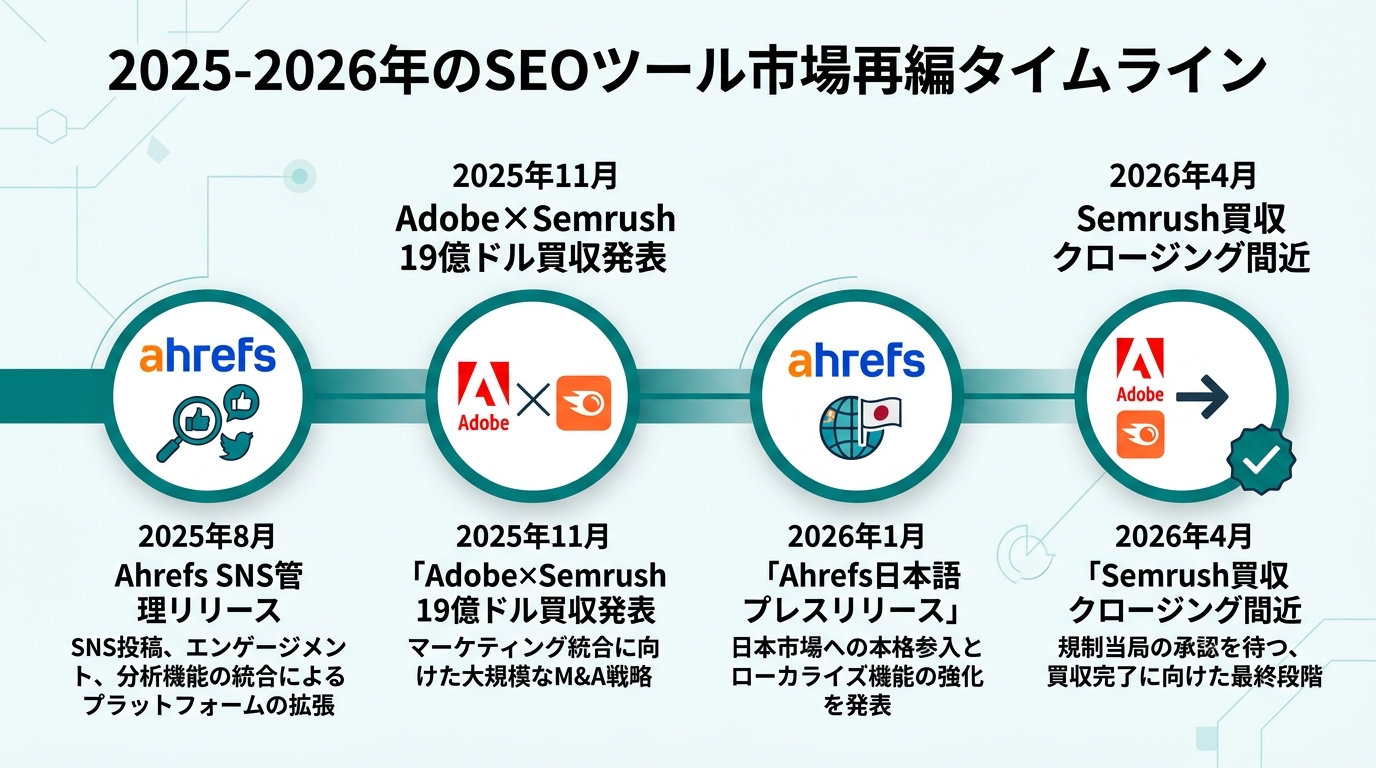
In August 2025, Ahrefs CMO Tim Soulo posted on X. “We’ve added a FREE Social Media Manager tool to Ahrefs” (Tim Soulo / X). Four supported platforms: X, Instagram, Facebook, LinkedIn. Post scheduling, simultaneous multi-channel posting, and AI content suggestions are built in.
A Japanese press release followed in January 2026 (PR TIMES). It explicitly lays out the intent: extend the know-how built up over 15+ years of SEO tool development into the social space.
On November 19, 2025, Adobe announced its acquisition of Semrush. The deal value is $1.9 billion, around 285 billion yen (Adobe Newsroom). As of April 2026, regulatory approval has been secured. Closing is expected within weeks (Daily Political).
Semrush is an integrated platform with 55+ tools spanning SEO, PPC, content, and social management. That’s being folded into Adobe Experience Cloud. A world where “SEO and social are unified inside the marketing foundation” is becoming reality.
The SEO tool market was around $84.9 billion in 2025. It’s projected to grow to roughly $295.1 billion by 2035 (Precedence Research estimate). Compound annual growth rate: 13.26%. In this massive market, top players are uniformly moving to “shed the SEO-only skin.” It isn’t coincidence.
The very premise that “SEO and social are different jobs” is being dismantled from the vendor side. That’s the heart of the shift over these eight months.
Three data points that refute “search and social are separate”
Why are vendors moving toward integration? The answer lies in user behavior change.
Data 1: 41% of Gen Z search on social rather than search engines
Sprout Social ran a study in Q2 2025. Conducted with research firm Glimpse, surveying 2,280 people in the US, UK, and Australia (Sprout Social press release).
The result was clear. 41% of Gen Z choose social as their first place to look for information. Traditional search engines came in second at 32%. Social overtook search engines for the first time.
The same study found that 37% across all age groups answered “I look at social first when researching product reviews and recommendations.” 35% also use social to search for “nearby restaurants and activities.” The entry point for search behavior is shifting onto social.
What this change means: “optimizing only for SEO misses Gen Z’s first touchpoint.”
Data 2: Social content is moving purchases
In the same Sprout Social study, 76% of respondents said “social content influenced a purchase in the past six months.” Limited to Gen Z, that’s 90%; for Millennials, 84%. Social has become a medium that influences not just “awareness” but right up to “purchase.”
A traditional funnel design — drive traffic via SEO, convert on a landing page — risks letting social-driven purchase decisions slip through.
Data 3: An era where Instagram content is shown directly in Google
In July 2025, Meta opened Instagram content from professional accounts to Google’s search index. Reels, feed posts, and carousels began appearing directly in Google search results.
This means “social content has become a target for SEO.” Post Instagram content with SEO-aware design and traffic flows in from Google as well. Conversely, posting without considering SEO means throwing away the inbound opportunity from Google.
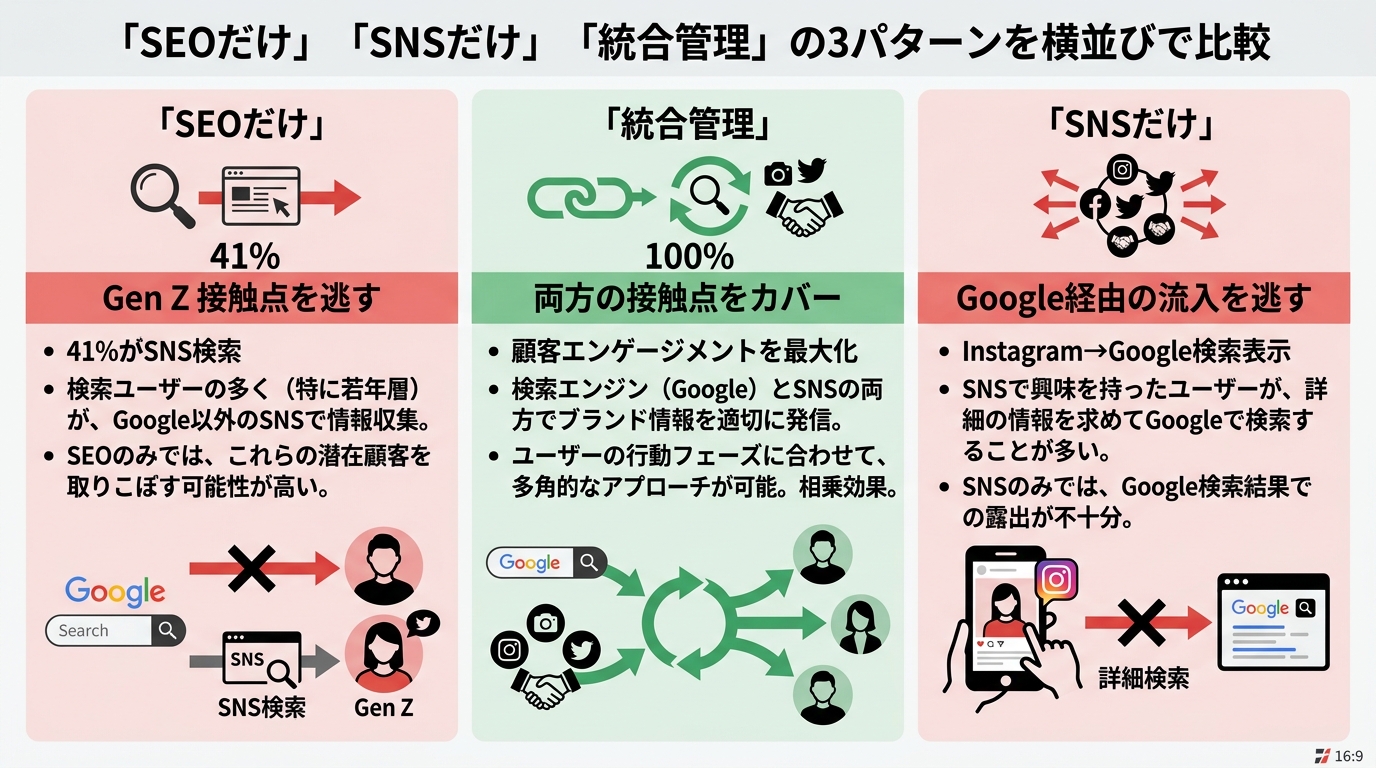
Lay out the three data points and the picture is clear. Manage search and social separately, and you miss three opportunities at once: Gen Z’s first touchpoint, social’s purchase influence, and inbound traffic from the Google × Instagram link-up.
Why “social-originated content” matters in the GEO era
Now let’s go a layer deeper. In the context of AI search — what’s known as GEO (Generative Engine Optimization) — social content is becoming more important as well.
There are cases where you rank #1 on Google but still don’t get cited by AI. I covered this issue in a previous piece (GEO series part 1). The citation logic of AI Overviews differs from traditional SEO rankings. Originality, structured answerability, and corroboration from diverse sources — these three matter most (GEO series part 2).
This is where social comes in.
When AI generates an answer, it doesn’t only reference web pages. YouTube videos, Reddit threads, LinkedIn posts. There are signals these social contents may also be referenced as information sources.
Say you ask ChatGPT or Perplexity “compare SEO tools for 2026.” Increasingly, the answer cites not just web articles but YouTube reviews and Reddit discussions. If your information lives only on your website, a competitor putting information out on social will steal the citation slot.
In GEO series part 3, I broke down “the structure of articles that get cited by AI” (/en/blog/n2026041300007301/). That same structure applies to social posts. Include clear headings and concrete numbers in long-form LinkedIn posts so they’re “easy for AI to assemble into an answer.” Organize X threads with numbered steps so the structure is clear and easy to cite. These tweaks lift visibility on the GEO side.
Conversely, when SEO and social are managed by different people in different tools, this thinking rarely emerges. The SEO lead chases page rankings; the social lead chases follower counts. The cross-cutting metric of “is this getting cited by AI?” falls into neither remit. The biggest benefit of integrated management isn’t tool efficiency — it’s strategic coherence.
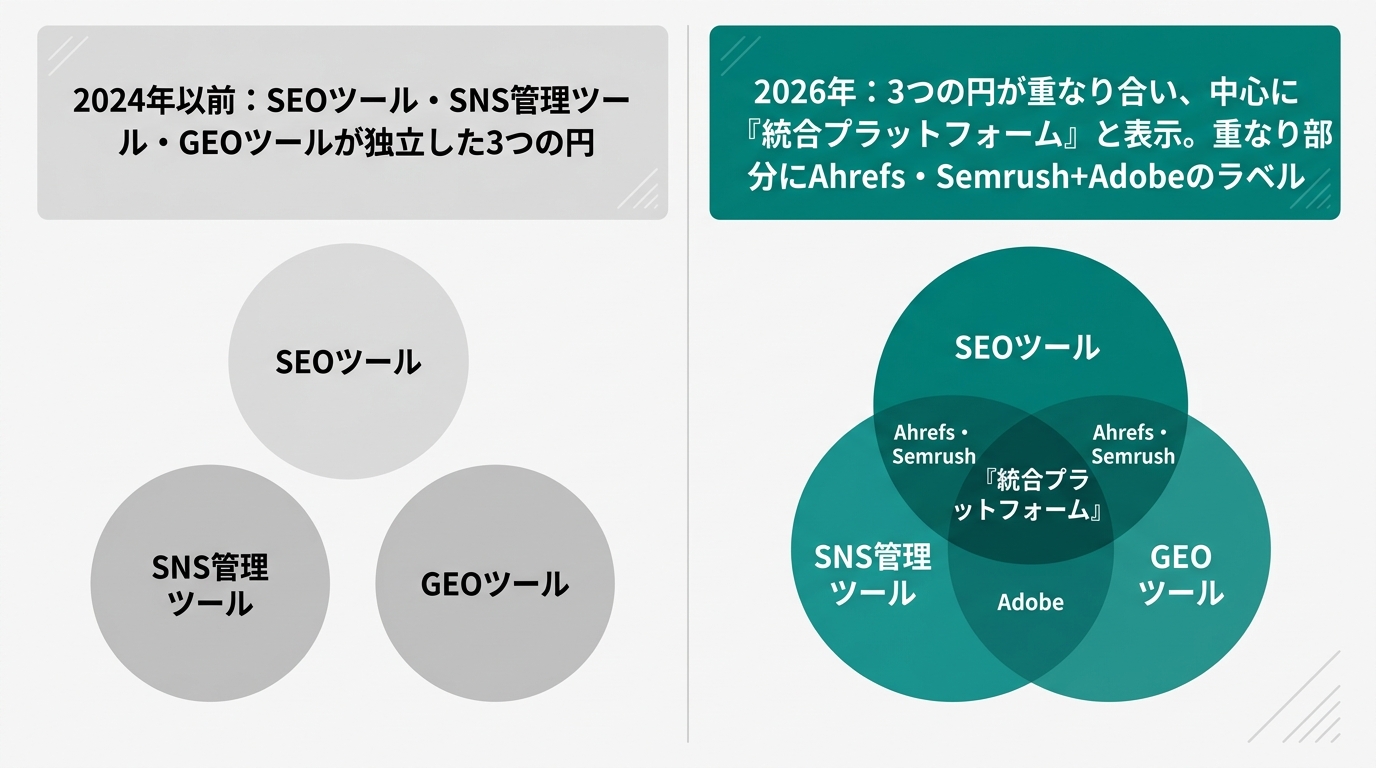
It’s not just Ahrefs. Tool vendors are redesigning around integration
Ahrefs’ move into social looks like one company’s play, but the whole market is moving the same direction.
Semrush: 55+ tools covering SEO, PPC, content, and social management. In 2025 it rebranded as Semrush One, consolidating AI features into the integrated UX. It also released an MCP server (September 2025), giving AI agents the ability to query Semrush data directly. And the integration into Adobe Experience Cloud is imminent.
Ahrefs: On top of social management, it has won ITreview Grid Award 2026 Winter in the LLMO and GEO tool categories. It’s redefining itself from “SEO tool” into “visibility platform.” The theme of the May 14, 2026 Singapore conference “Ahrefs Evolve” is “the front line of search and brand visibility in the AI search era.”
SEO software market overall: Per Precedence Research, growth from roughly $84.9 billion in 2025 to about $295.1 billion in 2035 (CAGR 13.26%). The main drivers of expansion are “AI integration” and “multi-channel coverage.” The shift from standalone SEO tools to integrated platforms is happening at the level of market structure.
Given that tool vendors are redesigning around integration, users need to revisit their management setup to match. Sticking with “separate tools are good enough” leaves the tool-side evolution unused.
Three steps to start integrating this weekend
For people thinking “I get that integration matters, but where do I start?”, here are three concrete steps. The design works for a solo marketer with 30 minutes a month.
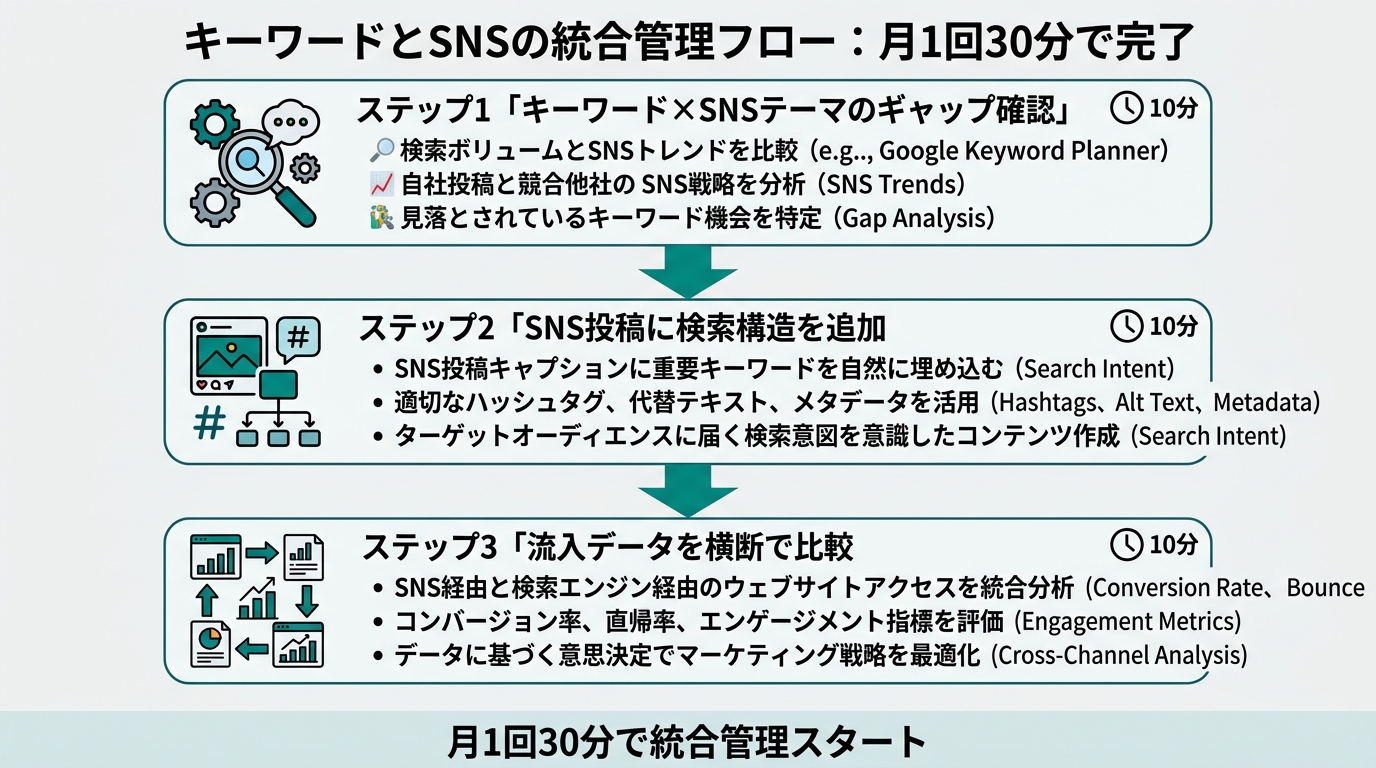
Step 1: Align search keywords with your social post themes (10 min)
In Ahrefs or Search Console, pull the top 10 keywords driving traffic to your site. Of those keywords, count how many are also themes you post about on social.
When I did this for my own site, only 3 of the top 10 were themes I was also publishing on social. The remaining 7 had only a search-side entry point. In other words, I was throwing away 70% of the chance to be discovered via social.
There’s a gap between the keywords you’re targeting in SEO and the themes you’re publishing on social. “Targeting ‘AI for productivity’ on SEO, but only posting daily musings on social.” Just recognizing this misalignment is the first step toward integration.
Step 2: Add “search-friendly structure” to social posts (10 min)
Add one SEO-style element to your Instagram, LinkedIn, and X posts. Specifically, any of the following:
- Naturally include searchable keywords in Instagram captions
- Add headings to long-form LinkedIn posts and put the claim up top
- Lead with the conclusion in the first tweet of an X thread
Given that Instagram content was opened to the Google index in July 2025, the value of “social posts that catch search” is higher than before.
Step 3: Once a month, look at inbound data side-by-side (10 min)
Put your search inbound data from Google Analytics and Search Console next to your social post performance data, in the same spreadsheet.
You’re checking just one thing: “Which themes have both high search traffic AND high social engagement?”
For example, suppose your blog’s “AI tool comparison” article pulls 500 search sessions a month, and your LinkedIn post on the same theme has 200+ likes. That domain is “where integration delivers the biggest payoff.” Focus there next month and ship the blog post and the social post simultaneously. Quote the blog’s key points on LinkedIn, and feed the social reaction back into the blog. Once that loop starts spinning, you’ll see results that neither SEO nor social alone could produce.
Ahrefs’ free plan covers the social management features (during beta, the post quota may vary by plan). If you want to try integrated tooling, getting hands-on with Ahrefs’ Social Media Manager is one option.
I previously unpacked what it meant when “Ahrefs started doing social management” (/en/blog/n2026033000003301/). About a month after that piece. The tool market is moving faster than expected, and the integration trend is accelerating.
Wrap-up: The cost of separate management piles up where you can’t see it
Three things people lose by managing SEO and social separately.
First, Gen Z’s touchpoint. In an era when 41% search first on social, SEO alone can’t form the first impression. Second, purchasing influence. The reality is that 90% of Gen Z have purchases swayed by social content. Third, inbound from the Google × Instagram link. Since July 2025, Instagram pro-account content shows up directly in Google search.
These aren’t the kind of losses where “today’s revenue drops.” They’re losses that bleed opportunity slowly. So they’re hard to see. By the time you notice, competitors who managed things in an integrated way have pulled ahead.
The tool market is moving the same direction. Ahrefs’ move into social, Adobe’s $1.9B acquisition of Semrush. Vendors have already concluded “integration is the answer.” We — the users — are at the point where we need to revisit our marketing setups on the same premise.
What to do is clear. This weekend, take 10 minutes and just do Step 1: “check the gap between your keywords and your social themes.” Lay out your top 10 SEO keywords next to the themes you publish on social. The size of the gap will likely surprise you.
I dig deeper into content strategy in the GEO era in the articles below.
- There are cases where you rank #1 on Google but don’t get cited by AI
- Decoding the citation logic of AI Overviews
- What’s the structure of articles that AI cites?
- What it means that Ahrefs started doing social management
The day you stop managing them separately is the starting line of marketing integration.
Source map
| # | Stat / figure | Source | Type | Year of study | Cited figure |
|---|---|---|---|---|---|
| 1 | Ahrefs social management feature release | Tim Soulo / X | Primary (official announcement) | August 2025 | Free social management tool added |
| 2 | Ahrefs social management tool — Japanese announcement | PR TIMES | Primary (official press release) | January 2026 | Supports X / Instagram / Facebook / LinkedIn |
| 3 | Adobe × Semrush acquisition | Adobe Newsroom | Primary (official announcement) | November 2025 | $1.9 billion (approx. ¥285 billion) |
| 4 | Semrush acquisition close imminent | Daily Political | Secondary (reporting) | April 2026 | Regulatory approval secured |
| 5 | 41% of Gen Z search on social | Sprout Social press release | Primary (research host’s official release) | Q2 2025 | Research firm Glimpse, 2,280 respondents, US/UK/Australia |
| 6 | Social content influenced purchase: 76% | Same as above (Sprout Social) | Primary | Q2 2025 | Gen Z 90%, Millennials 84% |
| 7 | SEO software market size | Precedence Research estimate | Secondary (market research firm estimate) | 2025 | $84.9B → $295.1B by 2035 (CAGR 13.26%) |
| 8 | Instagram content shown in Google search | Various media via Meta official announcement | Secondary (multiple media reports) | July 2025 | Pro accounts in scope |

AIを使いこなせない方は、この先どんどん差がつきます。僕はAIエージェントを毎日動かして、壊して、直して、また動かしてます。そういう泥臭い実践の記録をここに書いてます。理論は他の方にお任せしました。僕は動くものを作ります。朝5時に起きてウォーキングしてからコードを書くのがルーティンです。