"Time is the Currency." The 7 Habits Shared by 111 JPMorgan Billionaires (Combined $500B+) Were Surprisingly 'Ordinary'—Translating Them to a Solopreneur's Daily Life
JPMorgan's 2025 Principal Discussions Report surveyed 111 billionaires (combined net worth $500B+) on their 7 habits: reading, exercise, consistency, early rising, prioritization, goal-setting, and deep thinking time. Translating these 7 ordinary habits into a solopreneur's daily routine.
What you'll learn in this article
- The key point to grasp before reading the full article
- How the issue changes practical decisions after reading
- Which follow-up article is worth opening next

“Habits are important—you’ve heard that 100 times already, right?”
I used to think that too.
The 7 Habits of Highly Effective People. Atomic Habits. James Clear’s books. Walk into any bookstore and you’ll find a whole shelf dedicated to “success habits.” Open Instagram Reels and you’ll see “billionaire 5 AM routines” on loop. We’re sick of hearing about it.
But then I read JPMorgan’s “Principal Discussions Report” published in December 2025 (J.P. Morgan Private Bank Insights), and I had to stop.
“The currency of life is time. It is not money. You think carefully about how you spend one dollar. You should think just as carefully about how you spend one hour.”
—Anonymous comment from a participating billionaire (Fortune 2025-12-29)
This single line flipped the premise of every “habit book” I’d ever read.
It’s not about the “habits themselves.” There’s a foundation of “treating time in $1 increments,” and the habits sit on top of that.
Today I’m dissecting the 7 habits JPMorgan gathered from 111 billionaires (combined net worth $500B+) and translating them into a solopreneur’s daily life. If you think “I already know about habits,” I’d argue this article is even more worth reading. I found myself thinking, “I wish someone had told 17-year-old me this.”
The Fact “Habit Books” Don’t Cover, That JPMorgan Investigated
First, let me lay out the credibility of this study. I’m not just talking from gut feel.
JPMorgan Private Bank’s “Principal Discussions Report,” released in December 2025, is based on interviews with 111 of the firm’s wealthiest private bank clients. Their combined net worth exceeds $500B (about ¥75 trillion). That’s an average of $4.5B per person (about ¥675 billion)—the equivalent of a mid-cap publicly listed company in Japan, owned by a single individual. And 111 such people in one survey.
Fortune, Entrepreneur, and Business Insider all picked up this PDF because the combination—“111 billionaires, non-commercial internal study, $500B+ combined”—was unusual (Fortune / Entrepreneur).
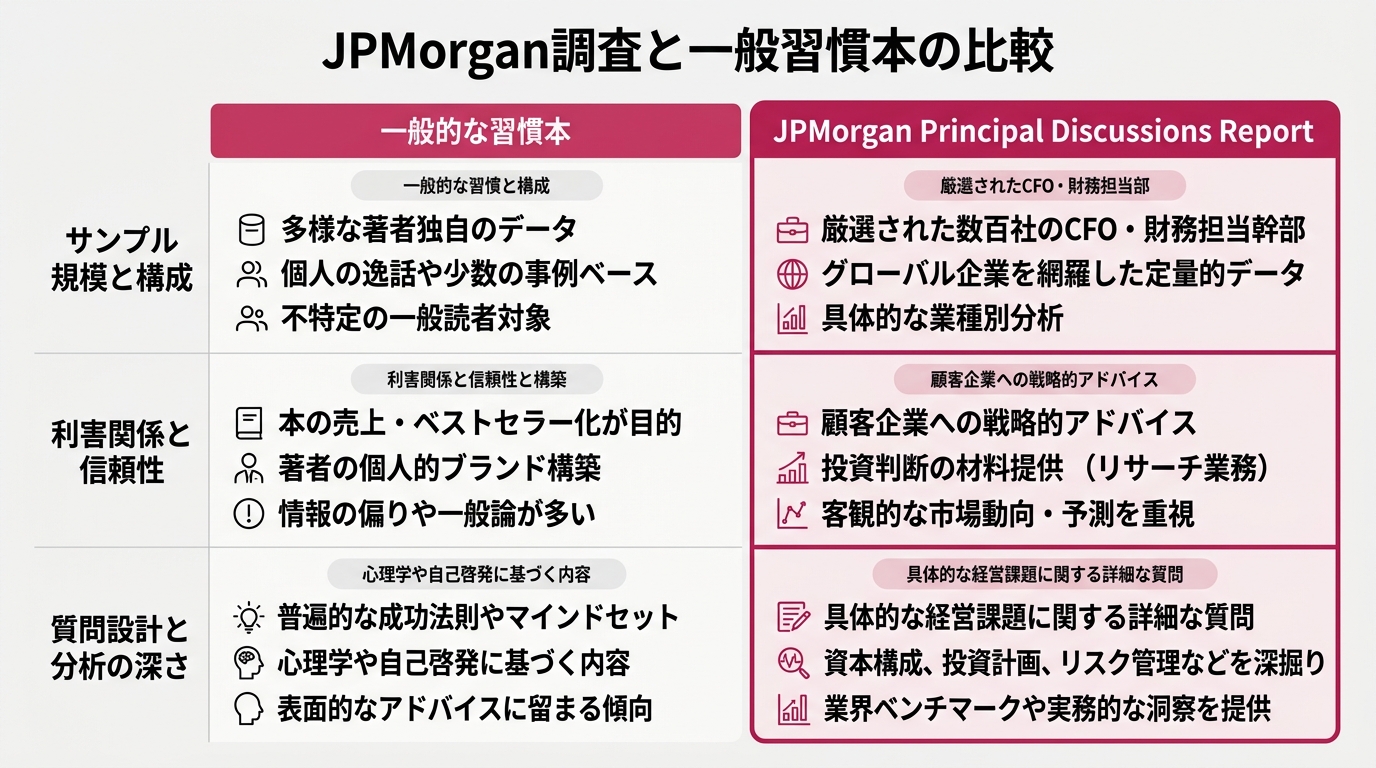
Here’s a side-by-side of typical “habit books” vs. the JPMorgan study. Three differences stand out.
Difference 1: Sample size and quality
- Typical habit book: 1 author’s experience + a few dozen case studies
- JPMorgan study: 111 billionaires, combined $500B+
“One person did it” vs. “111 people did it” carries vastly different weight as evidence of replicability.
Difference 2: Researcher’s commercial interest
- Habit book: The author wants to sell books (and coaching, and speaking gigs)
- JPMorgan study: Internal research for client understanding. Structurally less prone to commercial exaggeration
JPMorgan isn’t in the business of selling “habit books.” This is internal research to understand high-net-worth client behavior patterns, so commercial exaggeration is structurally unlikely. That said, the PDF itself includes a caveat: “We aggregated only topics that came up naturally; this is not a comprehensive survey.” You can read the trends, but it’s not an exhaustive map of every billionaire behavior pattern.
Difference 3: Depth of question design
- Habit book: Shallow questions like “What’s the secret to success?”
- JPMorgan study: Multi-hour conversations covering “your typical day,” “time allocation,” “investment decision processes,” etc.
According to Fortune’s reporting, the survey was conducted as roughly one-hour conversations per session. Not a surface-level questionnaire, but deep dialogue spanning lifestyle as a whole—which is how you get to the “real story.”
The 7 Habits Revealed—Ordinary Yet Behind $500B in Movement
Here’s the main event. The 7 habits 111 billionaires cited as “reasons for their success”:
- Reading
- Exercise
- Consistency
- Waking up early
- Prioritizing tasks
- Setting goals
- Deep thinking time
Honestly, my first reaction was, “Wait, that’s it? That’s so plain.”
I expected billionaires to say something more exotic. “Daily ice baths.” “A private chef managing every meal.” Something flashy.
But the value lies precisely in how plain they are. Anyone can start today, yet almost no one actually does—and that’s what produces the wealth gap.
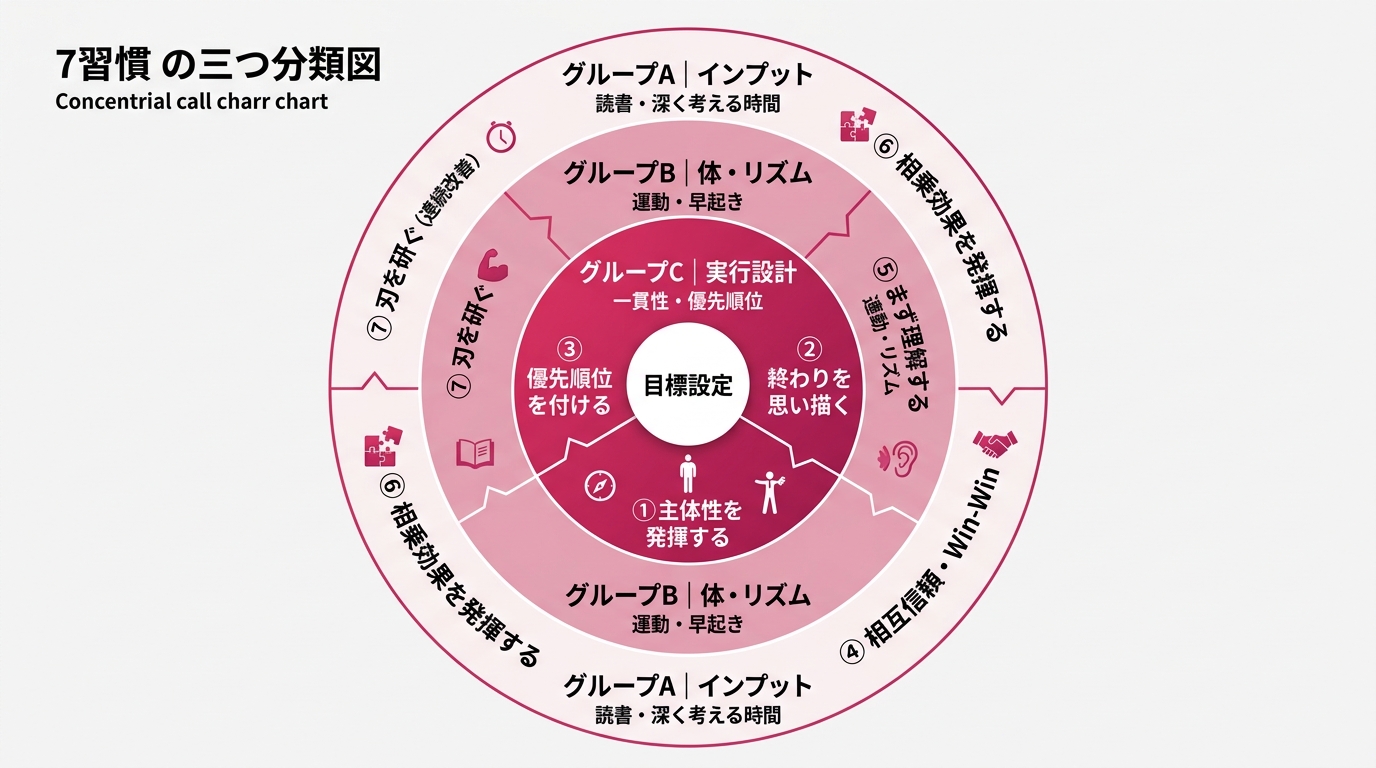
Let me organize the 7 habits into 3 groups.
Group A: Input (Reading & Deep Thinking Time)
- Reading: Install other people’s brains via books, articles, reports
- Deep thinking time: Dig into questions with your own brain
These two are a set. Reading alone leaves you stuck in “install mode”; deep thinking alone leaves you starved for material. Two wheels of a cart.
Group B: Body & Rhythm (Exercise & Early Rising)
- Exercise: Build a baseline of physical capacity. Even billionaires only have one body
- Early rising: Secure “your time”—a window when nobody can interrupt you
This group exists for sustainability. Not for a day or two, but to keep running for 20 or 30 years.
Group C: Execution Design (Consistency, Prioritization, Goal-Setting)
- Goal-setting: Decide where you’re heading
- Prioritization: Decide what to do today
- Consistency: Do what you decided, every day
The order matters here. Goals → priorities → consistency, in that order. The reverse doesn’t work.
The Real Difference Was in the “Unit of Time”
This is the most important point in today’s article.
If you only look at the list of 7 habits, you’ll think “yeah, I knew that” and move on. But read the body of the study and a deeper structure becomes visible.
“Across interviews, one theme dominated: extreme intentionality about how time is spent.”
—JPMorgan Principal Discussions Report 2025 (Fortune)
Recall that opening quote.
“If you think carefully about how you spend one dollar, you should think just as carefully about how you spend one hour.”
This is the essence. Billionaires manage “time” with the same precision as “money.”
For ordinary people, time is “a fuzzy chunk.” “This afternoon I have meetings.” “This week is busy.” We only grasp it in block-level units.
Billionaires are different. They think in terms of “what do I do with this 30 minutes?” “What can I move in this 5 minutes?”—down to $1 increments. Because to them, time is a scarce resource.
To make this concrete, here’s roughly the picture. (The comparison below is my own observation/inference, not a direct quote from the JPMorgan PDF.)
| Time Awareness Level | Ordinary Person | Wealthy |
|---|---|---|
| Unit | Half-day, 1 hour | 15 min, 5 min |
| Cost sense of “waiting” | Nearly zero | High |
| Reaction when “someone took my time” | Resigned | Prevented systemically |
| How priorities are decided | Morning of | Night before |
This gap determines the “implementation precision” of the 7 habits. Whether you read for 1 hour a week or stack 30 minutes daily, the annual gap is 150 hours. Over 10 years, that swells to 1,500 hours. This is the kind of accumulation that produces a $500B differential.
Conclusion: Before copying the 7 habits, train yourself to handle time in 15-minute units first.
This is what habit books don’t write about. They tell you “list out the habits and execute them,” but they don’t tell you “first, change your time awareness.”
Translating for the Solopreneur—Mapping the 7 Habits to a Daily Routine
Some of you might be thinking, “What does billionaire stuff have to do with me?”
Let me state this clearly. Solopreneurs and side-hustlers benefit the most from these 7 habits. Because there’s no organization—time management is entirely up to you.
If you’re an employee, your boss’s instructions, the meeting schedule, and the team’s deadlines fill your time as “external pressure.” But for a solopreneur, no one fills your time for you. If you don’t design your time yourself, nothing happens.
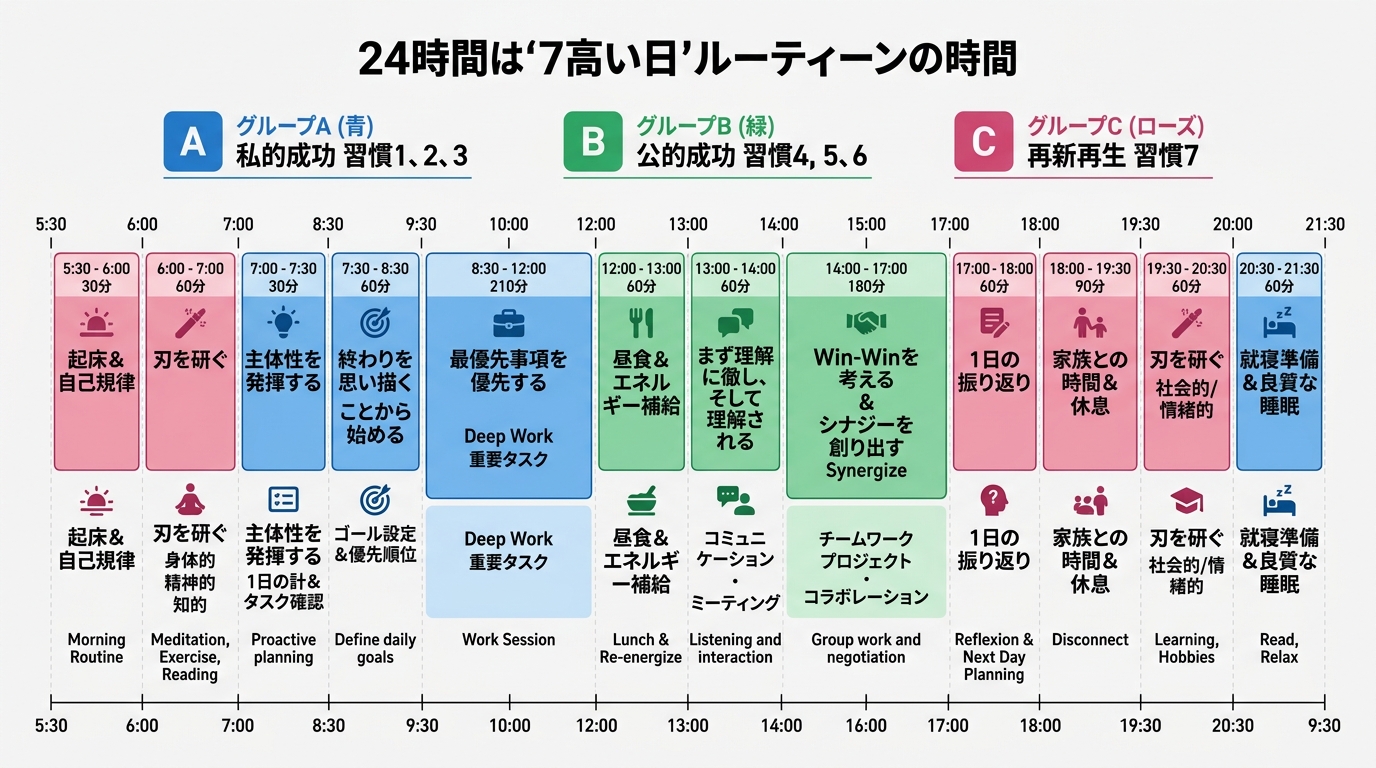
Here’s a sample of mapping the 7 habits onto a daily routine. This is the configuration I’ve tested over the past two years that actually works.
Morning 5:30–6:30: Group B (Exercise & Early Rising)
Exercise as soon as I wake up. 30-minute walk or light strength training. The reason is simple: if I don’t wake my body up here, afternoon performance drops. “The moment you wake up is the moment you’re most free.” Family and clients aren’t messaging you in this time slot.
Morning 6:30–7:30: Group A (Reading & Deep Thinking Time)
Read a book, an industry report, or someone else’s newsletter for 30 minutes. The remaining 30 minutes is time to write down “what I’m currently curious about” in a paper notebook. Reading alone leads to input overload, so always pair it with output.
Morning 7:30–8:00: Group C (Goal Review & Prioritization)
Write down 3 things to do today. From the “5 things to do tomorrow” I wrote the night before, narrow it to the top 3. Narrowing matters. If you write 5, you’ll finish none.
Daytime 9:00–18:00: Execution (Consistency)
Knock down the 3 in order. New tasks coming in? They go onto tomorrow’s list. “Today, do only what you decided to do today.” That’s the core of consistency.
Night 21:00–21:30: Tomorrow’s Design (Deep Thinking Time + Goal-Setting)
Today’s review. Write 5 things for tomorrow. Once a week, check the distance from “this month’s goal.”
Run this routine for 365 consecutive days, and you secure 1,000+ hours of “your time” annually. From the perspective of my employee-era self, that’s another world.
The Contradiction: Reading Was #1, But #7 as a Hobby
The most interesting finding from the JPMorgan study was this.
“Reading ranked No. 7 among hobbies and interests participants said they were most passionate about—trailing outdoor activities, time with family and friends, and even work itself.”
—JPMorgan Principal Discussions Report 2025 (Fortune)
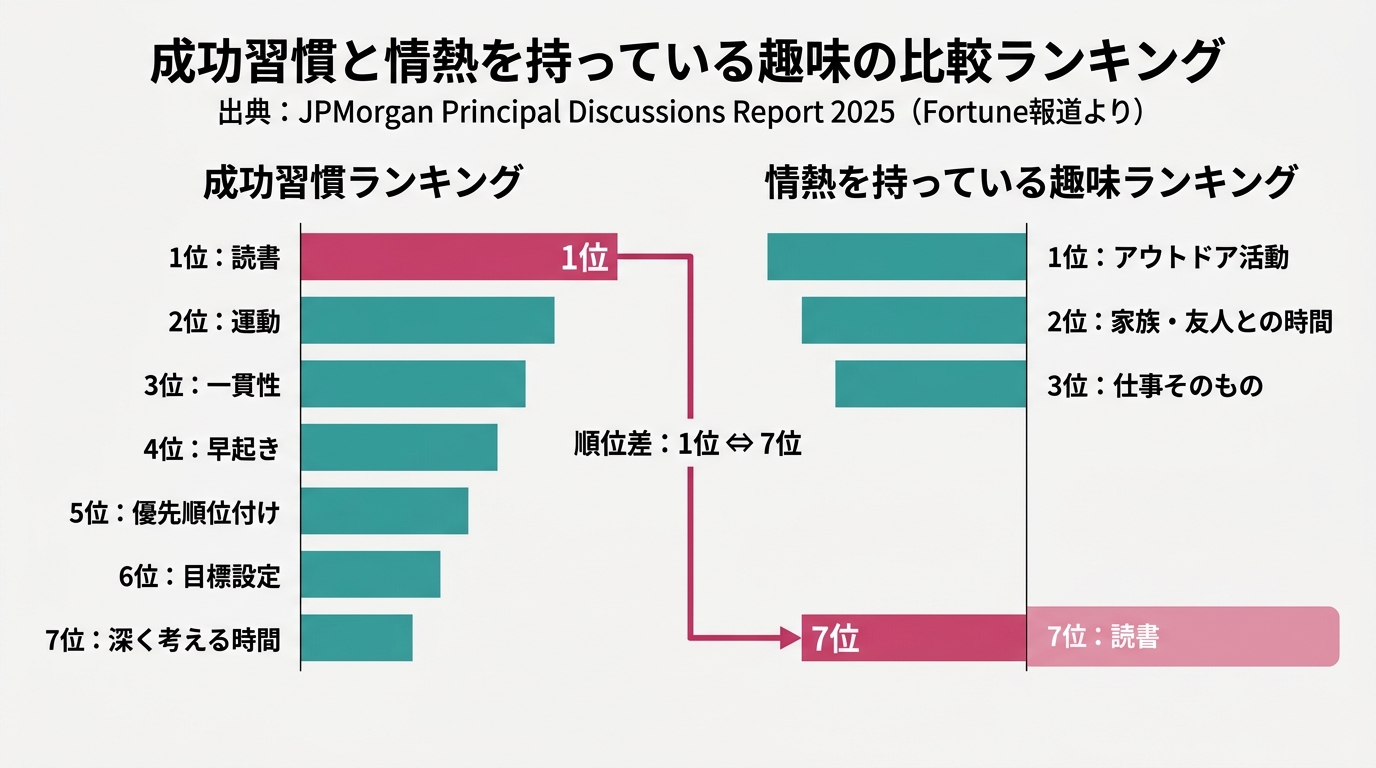
Doesn’t this contradict?
They’re saying “reading is the most important for success,” but answering that “what I personally enjoy is something else.”
At first I thought, “they’re being inconsistent.”
But thinking it through, the true nature of billionaire reading is hidden here.
For billionaires, reading isn’t a “hobby.” It’s “strategic discipline.”
Not “I read because it’s fun” but “I read because it leads to results.” That’s why it ranks low in passion. But in strategy, it ranks #1.
This is a major difference from ordinary people.
Ordinary person’s reading: “Read interesting-looking books when I feel like it” Billionaire’s reading: “Read books directly tied to a goal, on a schedule”
Concretely, here’s what differs.
| Comparison Item | Ordinary Reading | Strategic Reading |
|---|---|---|
| Selection criteria | Looks interesting / trending | Directly tied to this quarter’s challenge |
| When to read | Spare moments | Blocked into schedule |
| After reading | ”That was interesting” and done | Converted into action items |
| Review frequency | Never | Monthly, quarterly |
| Re-read same book | Never | Important books, 3+ times |
Building on the 4/18 article “I know habits matter. The question is which habits, in which order”, let me propose one thing.
Build “this quarter’s business challenge list” first, and pick exactly one book that solves it.
Not “10 business books a month.” “Read one book deeply, directly tied to this quarter’s challenge.” That’s billionaire-style reading.
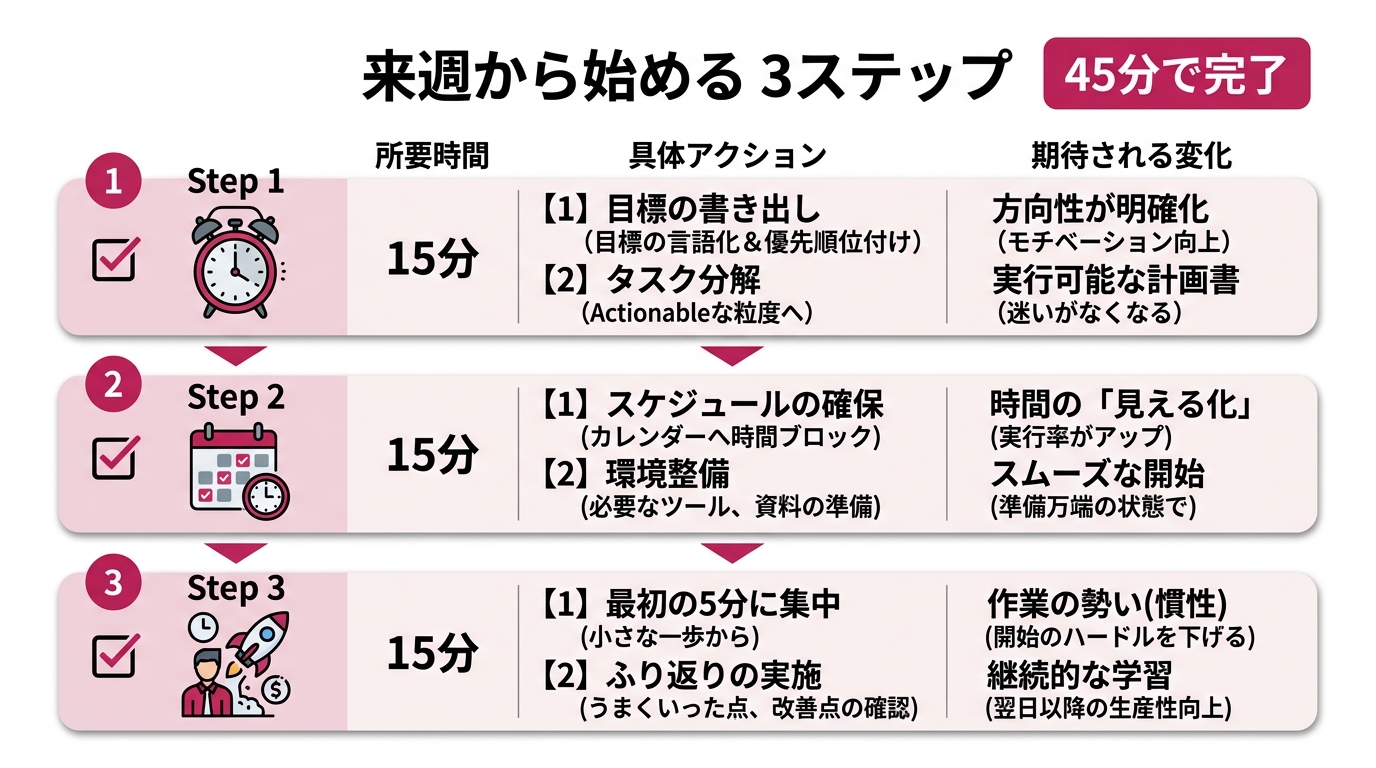
3 Steps to Start Next Week
For those of you who’ve read this far, here are 3 actions to start next week.
Step 1: Calculate “1 hour = ◯◯ yen” (10 minutes)
Calculate your hourly rate. If you’re employed, take your annual salary divided by 2,000 hours. If you’re freelance, take the past 3 months’ revenue divided by working hours. Done.
Once you have the number, write it on a memo and post it where you’ll see it.
Like, “My 1 hour = ¥5,000.”
This is the first step toward “treating time in $1 increments.” You’ll start to think about “the use of 1 hour” with the same precision as “a ¥5,000 decision.”
Step 2: Pick the 1 habit out of 7 you’re not doing (5 minutes)
Look at the 7 habits and pick 1 you’re not currently doing.
- Not reading → In Step 3, pick just one book
- Not exercising → Start a 30-minute morning walk this week
- Not waking up early → Just 30 minutes earlier
- No consistency → Decide on “1 thing to do every day”
- Not setting morning priorities → Write 5 the night before
- No goals → Write your destination 3 months out, in one line
- No deep thinking time → 30 minutes of solo time, once a week
Don’t try to do them all. Just one.
Step 3: Buy 1 book directly tied to “this quarter’s business challenge” (30 minutes)
At a bookstore or on Amazon, pick 1 book directly tied to your biggest challenge this quarter. Not “looks interesting”—pick on the “problem-solving” axis.
Once you buy it, look at the table of contents and read only the chapters where you think “the answer is probably here.” You don’t need to read the rest.
This is the entry point into billionaire-style “strategic reading.”
The 3 steps total 45 minutes. Do them once this weekend, and from next week the world changes.
Summary—From “Knowledge of Habits” to “Precision of Time”
The story so far in 3 lines.
- The JPMorgan 2025 Principal Discussions Report’s 7 habits gathered from 111 billionaires (combined $500B+) are: reading, exercise, consistency, early rising, prioritization, goal-setting, and deep thinking time. Ordinary—but ordinary is exactly why “anyone can replicate them today.”
- More than the 7 habits themselves, the intentionality of “treating time in 1-hour units, no, 15-minute units” is the real difference. Billionaires manage time with the same precision as $1.
- Reading ranks #1 in “success habits” but #7 as a “hobby.” For billionaires, reading isn’t pleasure—it’s “strategic discipline.” Read one book deeply, tied directly to this quarter’s business challenge.
Back to the start.
“Habits are important—you’ve heard that 100 times, right?”
You’ve heard it 100 times, so why haven’t you implemented? Because you’re trying to handle “habits.” What you should actually handle is “time.”
Raise the precision of time, and the habits ride along automatically. Conversely, if time stays fuzzy, no habit list survives 3 days.
The answer JPMorgan got from 111 billionaires was: “Time is the currency.”
This is the conclusion I re-organized this week, looking at my own credit card statement again (see: the 4/29 article “My AI tool spend, $300/month”). If you manage how you spend money in fine detail, manage how you spend time at the same precision. That’s “the management sense of a solopreneur.”
In my employee days, I did both time and habits “fuzzily.” After going independent, I realized time is a scarce resource. The moment I realized that, the 7 habits slid into my body.
Starting next week, try treating time in $1 increments. Your world will change.
If you’re hesitating, just do Step 1—the “hourly rate calculation.” It takes 10 minutes. I’ll go first and leave a format for you.
Related articles:
- “I know habits matter. The question is which habits, in which order.” Turning the JPMorgan × Mark Cuban answer into a “blueprint” — Part 1 of the 4/18 habits series
- My AI tool spend, $300/month. Have humans do the same work and it’s $80,000+/month — Translating money precision into the AI stack
- Five tools is enough. The $87/month solopreneur AI stack that just runs — The narrowing-down practice edition
- Polsia ¥670M, Medvi ¥60B, Levelsio ¥450M: 5 unicorn-realization cases — Senior practitioners implementing the 7 habits at $500B scale
Sources:
- Fortune: The world’s wealthiest families adopt these 7 key habits for success, according to JPMorgan (2025-12-29)
- Entrepreneur: Billionaires Credit These 7 Ordinary Habits for Success, According to JPMorgan
- J.P. Morgan Private Bank Insights (host page for the Principal Discussions Report) — The primary report can be obtained from this page

女性だからこそ、AIを使いこなさなきゃって思ってる。仕事も、副業も、推し活も、旅行も、全部やりたい。人生一度きりなのに時間は足りないじゃん?だからAIに任せられることは全部任せる。浮いた時間で本当にやりたいことをやる。それがあたしのスタイル。ここにはあたしが実際にやったことをまとめてるだけ。誰かのためになったらいいなって思って書いてるよ。