95% of Companies Just 'Took the Training': MIT Study Reveals the Structure of Failure and 3 Conditions for Production Deployment
MIT research reveals 95% of AI investments yield zero returns. We break down the difference between companies stuck at training and those reaching production, with domestic case studies and 3 key conditions.
What you'll learn in this article
- The key point to grasp before reading the full article
- How the issue changes practical decisions after reading
- Which follow-up article is worth opening next
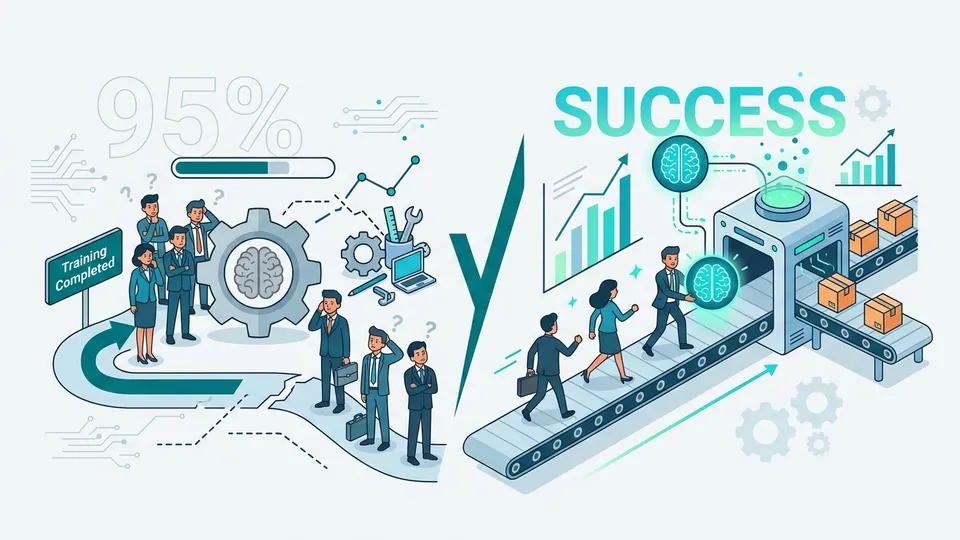
Your employees have taken AI training. They’ve attended ChatGPT seminars. Yet three months later, not a single workflow has changed.
If this sounds familiar, your organization likely has “training-stuck syndrome.”
According to the latest research from MIT (Massachusetts Institute of Technology), 95% of corporate AI investments end with zero returns. The cause isn’t a lack of AI capability. It’s the inability to break out of the loop: from training to PoC, from PoC to abandonment.
This article unpacks the decisive difference between companies that stop at training and those that reach production deployment, drawing on the latest data and domestic case studies. Then it distills the findings into three actions your organization can start this week.
95% of AI Investments Yield Zero Returns. “Training-Stuck” Is Happening Everywhere
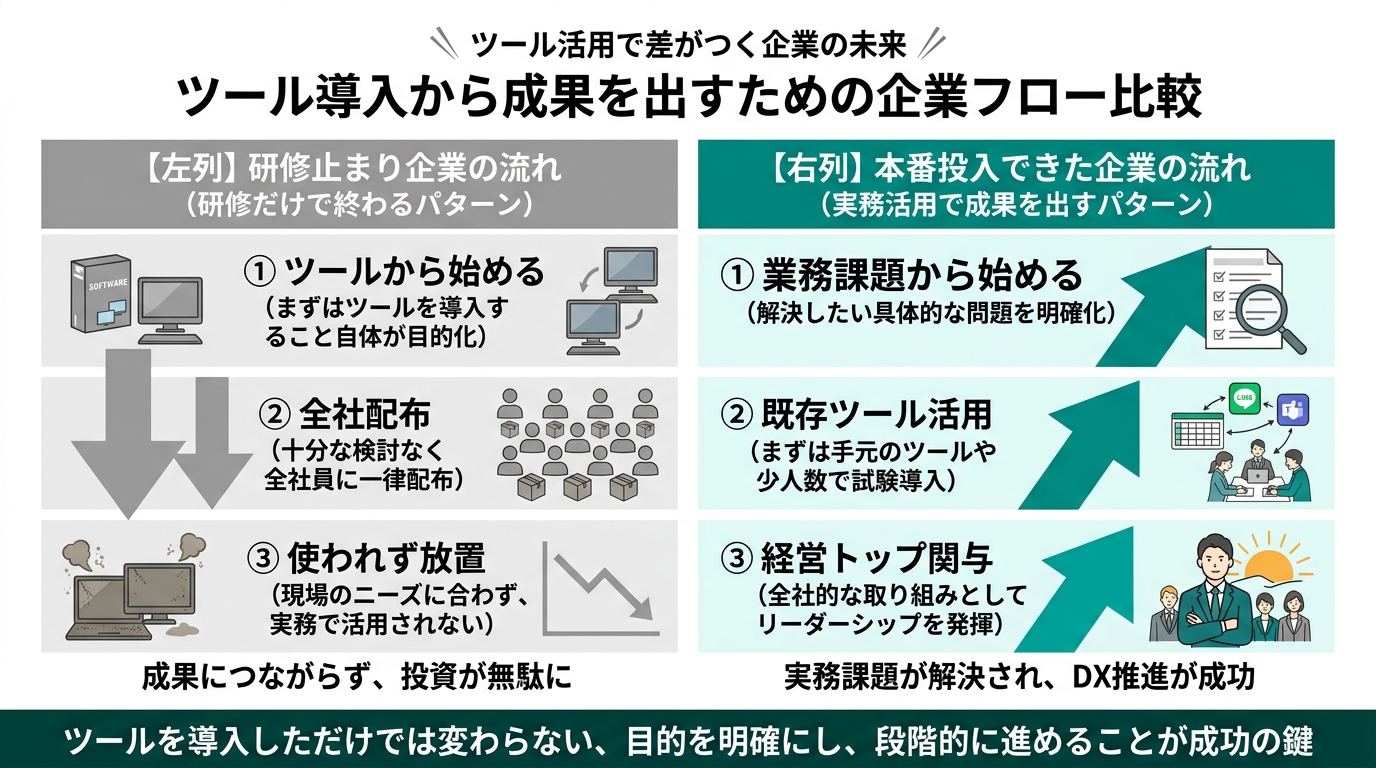
The biggest reason AI training fails to change operations isn’t a lack of AI capability — it’s the absence of “workflow integration design.”
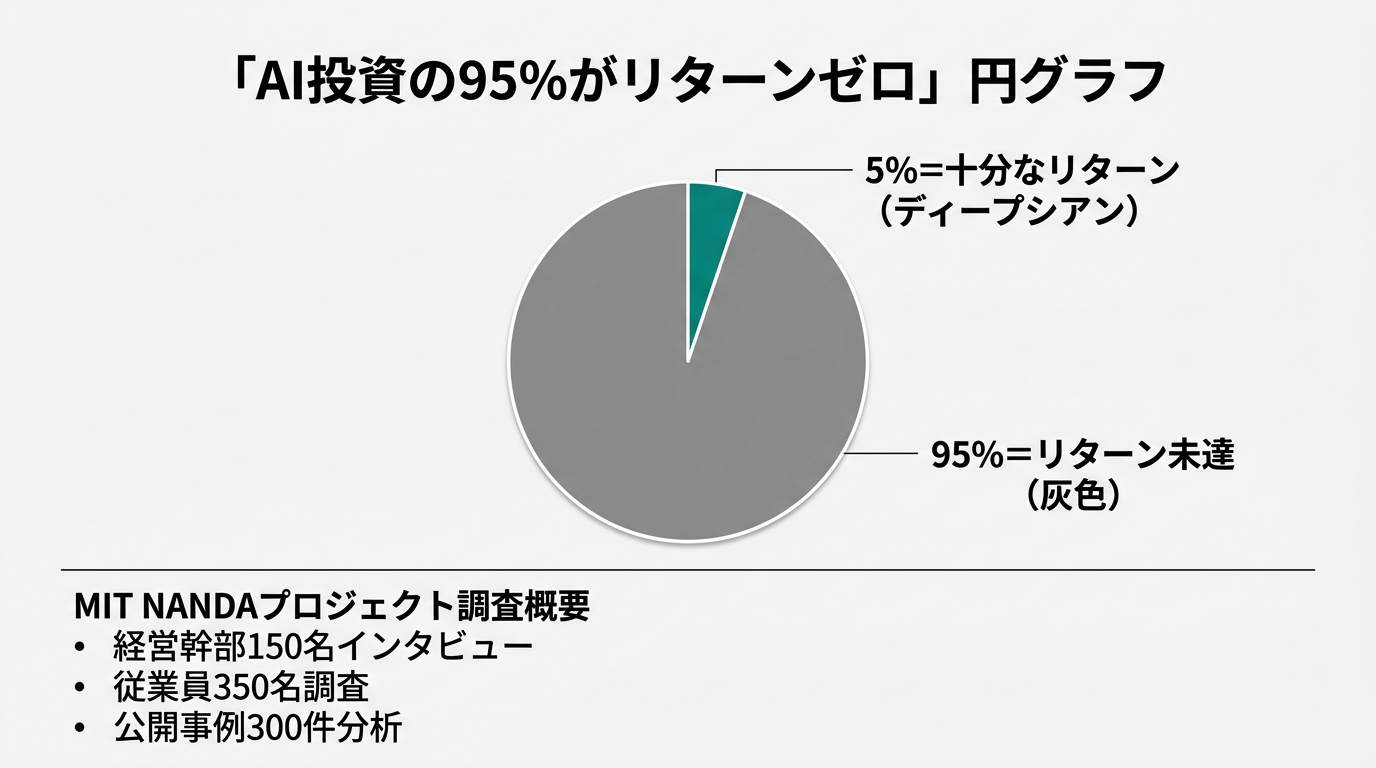
MIT’s NANDA project released a report titled “The GenAI Divide” in August 2025. Corporate generative AI investments have reached $35–40 billion (approximately ¥5.1–5.9 trillion). Yet only 5% are seeing sufficient returns (Toyo Keizai Online).
The study isn’t small in scale. It analyzed 150 executives, 350 employees, and 300 public case studies (Virtualization Review).
Honestly, when I saw these numbers, I wasn’t surprised. The exact same thing was happening at companies all around me.
“We had every employee take a ChatGPT seminar.” “We outsourced AI literacy training to an external firm.” Companies get this far. But ask them whether workflows have changed three months later, and in almost every case, nothing has changed. I’ve named this phenomenon “training-stuck syndrome.”
The typical flow of training-stuck syndrome goes like this. First, executives issue the call: “We need to do AI too.” Next, IT or HR arranges external training. Employees attend a half-day or full-day session. The following week, everyone returns to their original work. Training materials sit somewhere on their PCs, never opened again.
This isn’t just a Japanese issue. But domestic numbers show the same trend. According to Nomura Research Institute’s generative AI survey (January 2025), 57.7% of Japanese companies have already deployed generative AI. Yet only about 28% report getting “results beyond expectations.” That’s a roughly 30-point gap between deployment and results. The identity of this gap is exactly “training-stuck.”
The 3 Failure Patterns That Cause “Training-Stuck”
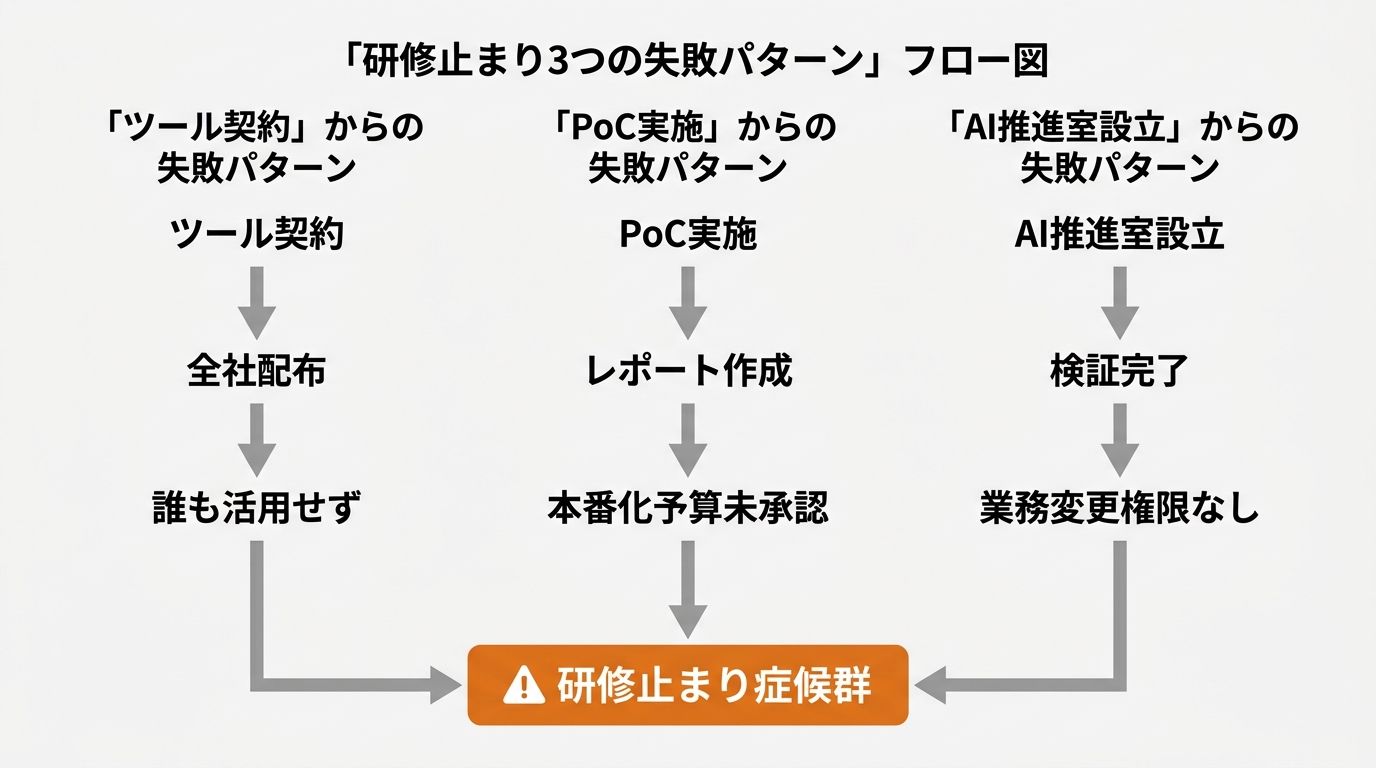
Companies that stop at training share three common patterns. I’ve organized them by combining MIT NANDA report analysis with cases I’ve seen firsthand.
Pattern 1: Buying tools without deciding “what to use them for”
This is the biggest failure factor MIT identifies. Many companies try to drop generic off-the-shelf AI products onto existing business processes as-is. Deployments that start with “let’s just sign a ChatGPT Enterprise contract” have a high probability of stalling.
Why do they stall? AI isn’t omnipotent. “Change this step of this process this way.” Without that design, distributing tools just leaves employees using them as “convenient search tools.”
Here’s where the expectation gets interesting: “If we teach how to use it in training, adoption will spread naturally.” Unfortunately, that’s almost never how it plays out. Employees who are simply handed tools fall into a state of “I don’t know what to ask.” Without a “translator” standing between business problems and tools, training ends as nothing more than a knowledge input session.
Pattern 2: Letting PoC end at “we tried it”
Many AI projects get stuck at the PoC stage. They make it through PoC. They write a report saying “we got interesting results.” And there, very often, the work stops.
Between PoC and production deployment lie three walls: security, data integration, and operational structure. Starting a PoC without a plan to cross these walls leads to the classic checkmate: “validation succeeded but the production budget didn’t get approved.”
To be specific, security reviews often take at least 2–3 months. During that time, “the project lead got transferred” or “the executive sponsor was replaced,” and the project quietly dies. Designing the production approval process before starting the PoC is the only way to avoid this trap.
Pattern 3: Outsourcing everything to the “AI Promotion Office”
What MIT identified as a common trait of successful companies was “direct CEO oversight.” Companies that created dedicated departments and handed everything off saw dramatically lower success rates.
The reason is clear. AI’s value is inseparable from business process changes. An AI Promotion Office without authority can validate tools. But it can’t get to the point of actually changing how work is done.
For example, when introducing “automated sales report generation,” does the AI Promotion Office have authority to change the report format? In most cases, no. So they progress through validation but stop at implementation.
In my experience, companies that hit two or more of these three patterns almost certainly end up “training-stuck.” Conversely, breaking even one of them gets things moving.
What Companies That Built “Something Working on Setup Day” Actually Did
So what was different about the 5% of successful companies? Let’s read it through the three common conditions identified by the MIT NANDA report.
Condition 1: Start from the problem
Successful companies don’t enter from “what can AI do?” They enter from “how do we solve this business problem?”
There’s a symbolic domestic case. It’s the Claude Code deployment support service provided by Comix. Aimed at SMEs without dedicated IT staff, the service runs a demonstration on setup day that puts AI to work on actual business problems. Environment setup, guideline drafting, and adoption training all wrap up in a single day (PR TIMES).
What’s worth noting is the reversal of order: not “train first, then apply to work,” but “learn while solving business problems.” Solve the problem first. Learning comes after.
When I first touched Claude Code myself, I had it organize folders before reading any manual. I tried it half-doubting “can this really work?” — and it worked. From that moment, I started learning how to use it. If I’d done training first, I’d have been at least a week behind.
Condition 2: Use existing tools
Successful companies don’t build proprietary AI from scratch. They deploy existing products like Claude Code or Cursor directly onto their business processes.
ARI (AR Advanced Technology) also fits this condition. They equipped every engineer and consultant with Claude Code as standard (ARI disclosure). They chose to roll out a commercial tool company-wide rather than build their own, and adjust their business processes to match.
As I covered in “A Japanese IT Company Equipped Every Engineer with Claude Code,” spending six months on tool selection is dangerous. The market shifts during that time.
Condition 3: Top management gets involved
This isn’t motivational fluff. Changing business processes requires decision-making authority, and changes don’t get executed unless the person with that authority is directly involved. It’s a structural issue.
According to Nikkei (March 2026), Fancl and Mitsubishi Corporation fully incorporated AI into their 2026 new employee training programs (Nikkei). Both have direct executive decision-making behind them. Without movement from the top, no matter how good the tool, you can’t escape “training-stuck.”
40% of AI Agents Will Be Cancelled by 2027. Here’s Why You Should Still Move
After reading this far, some of you may feel “maybe it’s too early for us.” That judgment is half right, half wrong.
Gartner released a prediction in June 2025. It targets agentic AI (AI that judges and executes autonomously) projects. Over 40% of them are expected to be cancelled by the end of 2027 (Gartner).
The reasons for cancellation are cost overruns, unclear business value, and inadequate risk management. Behind the cancellations is also “agent washing” — the practice of simply re-labeling existing products as agents. According to Gartner, out of thousands of vendors, only about 130 actually have agentic capabilities.
That said, the same Gartner has another prediction. By 2028, over 15% of daily business decisions will be made autonomously by AI. That number was 0% as of 2024.
“40% will be cancelled” is a fact, but “the remaining 60% will accelerate” is also a fact. The question isn’t “do it or not.” The design of “how to do it” determines everything.
A Gartner survey (January 2025, 3,412 webinar participants) is also interesting. 19% of companies have already made major investments. 42% are progressing with conservative investments. Only 31% are waiting. The market is already moving.
I touched on this in “Just ‘Using’ AI No Longer Creates a Gap” too. According to Deloitte data, 88% of companies have deployed AI. Yet only 25% have moved to production operations. Whether you join that 25% or stay in the 75% depends on the decisions you make now.
Remember the fact that non-engineers flooded “the previous Claude Code seminar where 300 seats sold out early.” AI tool utilization isn’t just a developer story. Accounting, HR, marketing. Every department is being asked “what comes after training?”
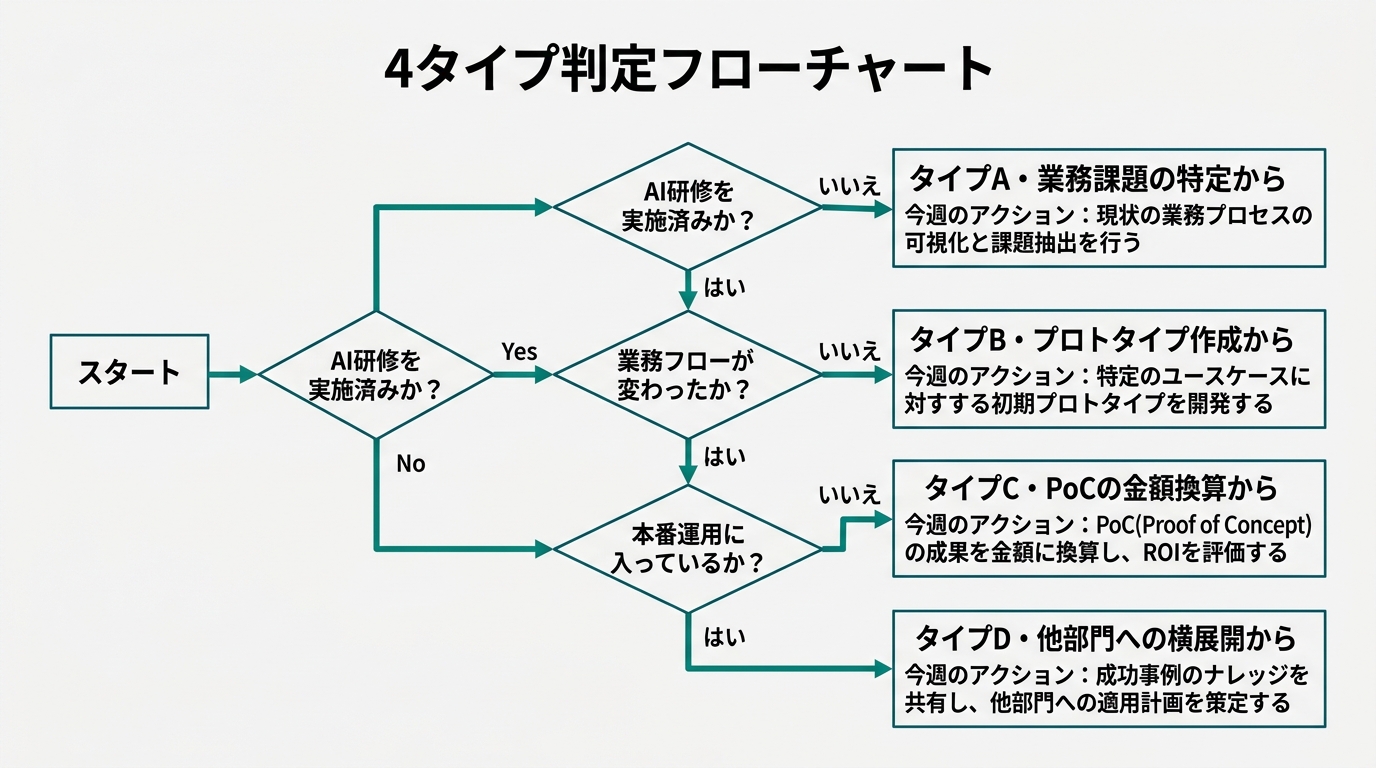
Which Type Is Your Organization? A “Training-Stuck” Diagnosis and This Week’s Action
From here, I’ll organize the next moves by reader type. Check where your organization stands.
Type A: Haven’t even run AI training yet
No need to panic. But “let’s start with training” is the wrong order. First, pick one business problem and try it with an existing tool like Claude Code. Training can come later. Remember that all the successful companies in the MIT NANDA report were “problem-first.”
→ This week’s action: Identify one of the most repetitive tasks in your company
Type B: Took the training. Work hasn’t changed.
This is the most common pattern. A state where no bridge has been built between training and work. The breakthrough is bringing a concrete proposal to executives: “I want to change this step of this process with AI.” The key is presenting concrete measures with monetary equivalents, not abstract “AI promotion.”
For example, a proposal like “I want to automate monthly report aggregation with Claude Code. 3 hours/month × ¥3,000 hourly rate = ¥9,000/month in labor savings” gets executives moving. The difference between saying “I want to use AI” and “I can cut ¥9,000 in labor costs this month” is enormous.
→ This week’s action: Use the tools learned in training to build a prototype that automates one real task. 30 minutes of work is enough. Don’t aim for perfection.
Type C: Made it through PoC. Stuck on production deployment.
You’re at the stage of identifying which of the three walls — security, data integration, operational structure — is the biggest obstacle. In most cases, it’s not a technical wall but a “who approves it” wall. Converting PoC results to monetary equivalents and presenting them to executives to draw out top-level involvement is effective.
→ This week’s action: Create a one-page report converting PoC results to monetary value as ”○ hours saved × labor cost rate”
Type D: In production operations. Thinking about the next phase.
You’re in the 5%. The next step is horizontally expanding from one successful task to other departments. As I wrote in “Non-engineers Flooded the Claude Code Seminar,” expansion beyond developers is the next growth phase.
→ This week’s action: Share success cases internally and solicit horizontal expansion candidates from other departments
Conclusion: Don’t Stop at Training. This Week, Pick One Business Problem.
95% of AI investments end with zero returns. The cause isn’t that AI doesn’t work. It’s the lack of a design to break out of the “training → PoC → abandonment” loop.
The three common conditions of companies that succeeded at production deployment are:
- Start from the problem: Enter from business problems, not tool features
- Use existing tools: Don’t build in-house; adapt your work to commercial tools
- Top management gets involved: People with authority to change processes move directly
While you’re standing there thinking “we’ll do this properly someday,” successful companies are building something that works on setup day. There’s one thing to do this week. Pick the most repetitive task in your organization. Try putting AI on it. Training can come after.
I myself run an AI agent system called Izumo every day. It’s a setup where multiple AI agents autonomously research, write articles, and review each other. I learned something in the process of building it. “Try one thing today, even if incomplete” produces results dramatically faster than “build a perfect design before moving.”
95% of companies keep saying “next year, we’ll really do it” every year. The 5% moved one thing this week. That difference starts with just one action this week. If you’ve realized you fall into Type A through C, try writing down “this week’s action” in your notebook before today ends. The moment you write it, you’ve got your ticket to the 5%.
Source Map (URLs Verified Live)
| # | Data/Statistics | Source | URL | Status |
|---|---|---|---|---|
| 1 | 95% of AI investments yield zero returns | MIT NANDA project “The GenAI Divide” (August 2025) / Toyo Keizai Online | https://toyokeizai.net/articles/-/911900 | ✅ 200 |
| 2 | Survey scale (150 executives, 350 employees, 300 cases) | Virtualization Review (August 2025) | https://virtualizationreview.com/articles/2025/08/19/mit-report-finds-most-ai-business-investments-fail-reveals-genai-divide.aspx | ✅ 200 |
| 3 | 57.7% domestic deployment, 28% results | Nomura Research Institute Generative AI Survey (January 2025) | URL redirects (report name only) | — |
| 4 | Comix Claude Code deployment support case | PR TIMES | https://prtimes.jp/main/html/rd/p/000000249.000002500.html | ✅ 200 |
| 5 | ARI company-wide Claude Code standard equipment | ARI disclosure | https://ari-jp.com/news/20260413/16278/ | ✅ 200 |
| 6 | Fancl/Mitsubishi Corporation AI new employee training | Nikkei (March 2026) | https://www.nikkei.com/article/DGXZQOUC261ZZ0W6A320C2000000/ | ✅ 200 |
| 7 | Agentic AI 40% cancellation prediction | Gartner (June 2025) | https://www.gartner.com/en/newsroom/press-releases/2025-06-25-gartner-predicts-over-40-percent-of-agentic-ai-projects-will-be-canceled-by-end-of-2027 | ⚠️ 403 (presumed bot protection, retained) |
| 8 | Deloitte 88% deployment vs 25% production transition | Deloitte survey | — | — |

AIを使いこなせない方は、この先どんどん差がつきます。僕はAIエージェントを毎日動かして、壊して、直して、また動かしてます。そういう泥臭い実践の記録をここに書いてます。理論は他の方にお任せしました。僕は動くものを作ります。朝5時に起きてウォーキングしてからコードを書くのがルーティンです。