12 Things Changed in Digital Marketing This May. A Thinking Framework for Picking Just One Move This Week.
May 2026 saw 12 significant shifts in digital marketing. Chasing all of them isn't realistic. Fold them into 3 axes, then narrow to 1 move for this week — a practical thinking framework built from ALM Corp and Semrush primary data.
What you'll learn in this article
- The key point to grasp before reading the full article
- How the issue changes practical decisions after reading
- Which follow-up article is worth opening next

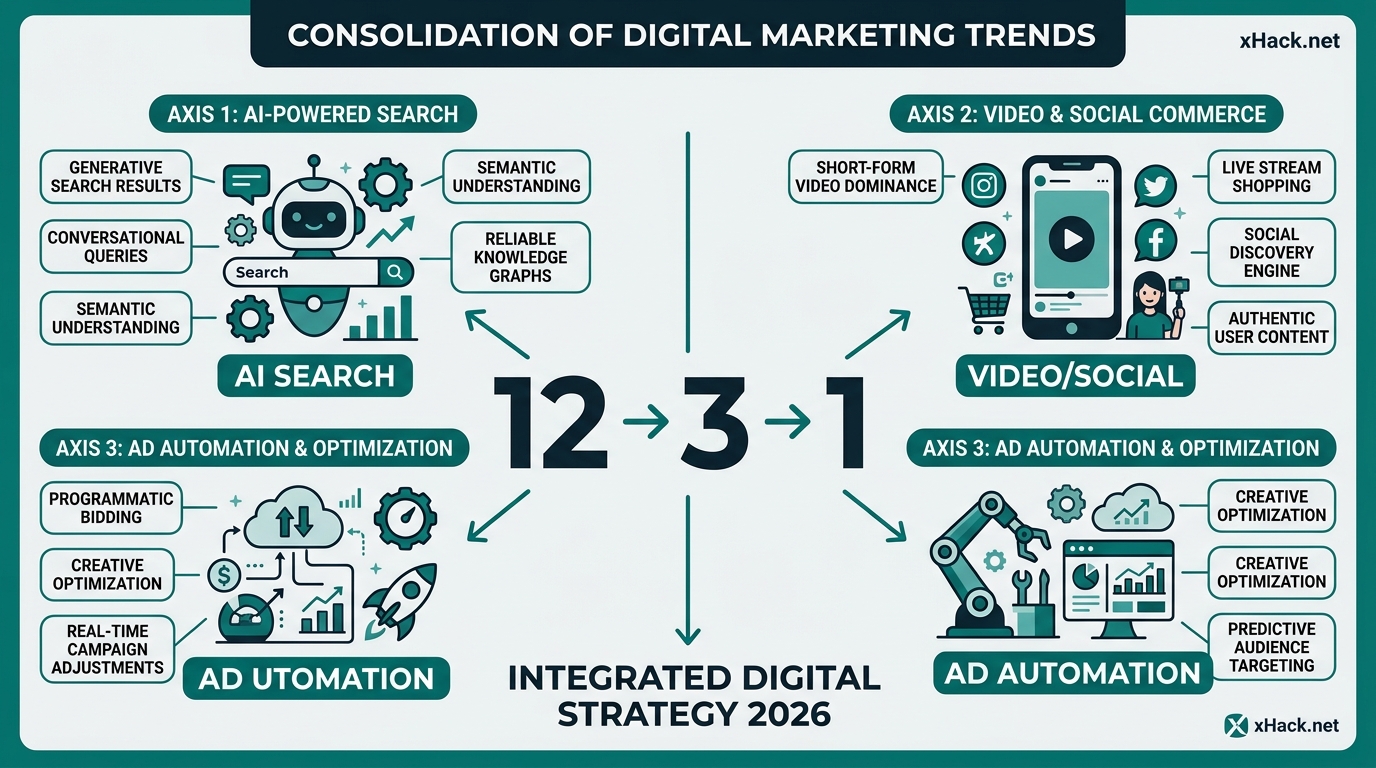
ALM Corp’s May 2026 monthly report lists “12 important changes” (ALM Corp May edition). AI search. SEO. Social. Video. Paid advertising. All directions.
My hands stopped when I read it.
Twelve. And every single one says “you should do this.” For solo marketers or small teams, chasing all twelve in parallel is not realistic.
This article folds ALM Corp’s 12 changes into 3 axes. Then it gives you a thinking framework for narrowing down to “the one thing you should move on this week.” By the time you finish reading, you’ll be in a state of “move 1 thing” rather than “chase 12 things.”
The Difference Between People Who Read Monthly Reports and Feel Overwhelmed vs. People Who Act
Every month, agencies and media outlets release their “this month’s digital marketing changes” roundups. Reports from partner-tier agencies like ALM Corp are especially comprehensive. Worth reading.
But they don’t always translate into action.
I was that person in the beginning. Bookmarks accumulating. Writing items into mind maps, then stopping. A new report arrives the next month, and the previous one’s tab closes without a second look.
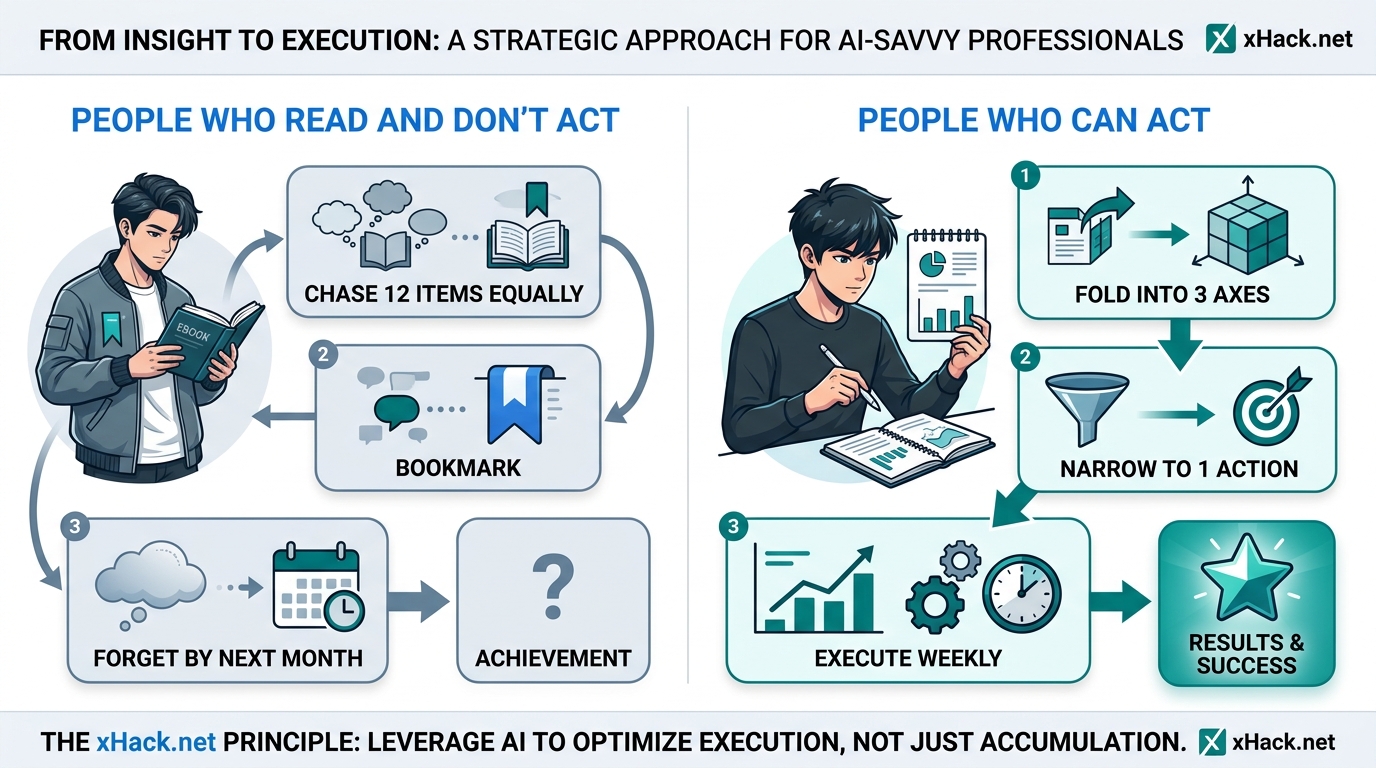
The decisive gap is whether you read the report as “information” or as “raw material for narrowing down action.”
“Reading it as information” means trying to understand all 12 items individually. “Reading it as material for narrowing action” means holding all 12 against your current position, assigning priorities, and cutting things.
Cutting things. That’s what matters.
The person who wrote the report wants to be as comprehensive as possible, so they list 12 items. The reader’s job is to fold 12 into 3, then 3 into 1. The person who compiled everything vs. the person who narrowed it down — of course their outputs are different.
The trap solo marketers and small-team marketers fall into when reading big-agency reports: “try to do everything the big players are doing.” That’s the most inefficient possible read for someone with limited time and budget.
I now open a three-axis template every time I read a monthly report.
- Axis 1: AI search (answer-led shift)
- Axis 2: Video and social (attention shift)
- Axis 3: Ad automation (input quality shift)
When 12 items appear, I first sort them into which of these 3 axes they belong to. Items that don’t fit any axis can be ignored that month. That’s my rule.
Once I do that, the items I actually need to move on usually narrow to 3 or 4. From there, deciding “1 thing to do this week” makes next week’s action visible.
From here, I’ll examine each axis with specifics. The core of the 12 changes ALM Corp’s May edition covers can be distilled to 3 axes. I’ll verify with data why each axis shifted this month.
Axis 1: AI Search — Search Changed from “List of Links” to “Answers”
What ALM Corp emphasizes at the top of their report is the idea that “search has become answer-led, not just link-led.”
This isn’t abstract — it has quantitative backing.
BrightEdge’s latest tracking shows AI Overviews (Google’s AI-generated summaries appearing above search results) were appearing on 48% of tracked queries as of March 2026, up from 31% the previous year — roughly 1.5x (ALM Corp May edition citing BrightEdge data).
Semrush also published a separate study of 10M+ keywords. In January 2025: 6.49%. Peak in July 2024: 24.61%. As of November: 15.69% (Semrush AI Overviews Study).
Click-through rate data is also out. When an AI summary is shown, 8% of users click the organic links below it. When there’s no summary: 15%. Roughly halved (Pew Research analysis as cited by Semrush: Semrush AI SEO statistics).
The premise “rank first and you’ll get clicks” is now working at only about half capacity.
What also catches attention is Google AI Mode’s adoption rate. Over 100 million monthly users in the US and India, 75 million daily actives. Multiple outlets are reporting this as “the fastest adoption of any Google search feature” (digitalapplied.com).
This isn’t a “future where AI Mode takes over” — the transition is already in progress.
As I’ve written across my GEO series, the new ranking isn’t “get to #1 on Google.” It’s “get cited when AI generates an answer.” See my earlier pieces for detail (Even if you rank #1 on Google, AI won’t cite you / What’s inside AI Overviews).
For AI search this month, there’s exactly one thing to do: pick your 5 most-trafficked pages and rewrite one in “AI-citation-friendly” format. Specifically: Q&A-formatted headings, conclusion placed at the top, explicit sourcing. This week, just one page. That’s enough.
Axis 2: Video and Social — Standing Out When 86% Use AI to Make Videos
The shared premise across video and social in the May report is: “the production norms have changed.”
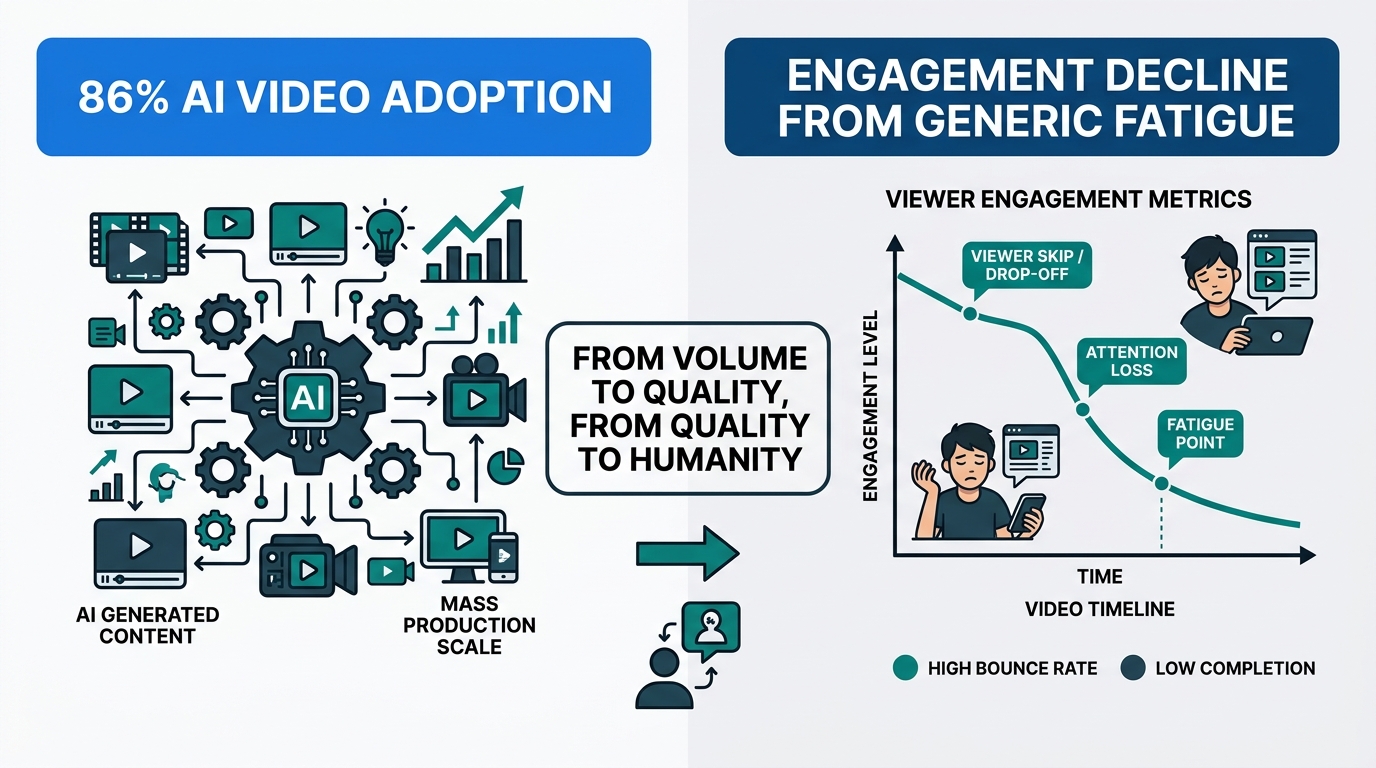
eMarketer data is widely cited. In 2026, 86% of advertisers running video ads are already generating or editing video creative with AI. And a projection: by end of 2026, AI-generated video ads will account for 40% of the total (ALM Corp May edition citing eMarketer data).
Reading only the numbers, you might conclude “AI democratized video production, great.” But the competitive rules just changed.
“Anyone can make video” being widespread means volume alone no longer creates differentiation.
What ALM Corp goes on to point out is “generic fatigue” on social platforms. Audiences are starting to tire of high-volume, template-feeling videos. Reaction rates, completion rates, comment rates — some advertisers are seeing these drop.
I feel this in practice. Open Instagram and you get a run of similarly-structured videos. Videos that smell like AI production get skipped within the first two seconds.
What works here is native feel and first-person experience.
- Videos shot on your own phone, with rough editing
- Genuine moments, including failures, without polish
- Improvised responses to questions that came in from followers
In other words: rather than increasing quality with AI, go the other direction — use the AI era as a reason to keep “human-ness” as a contrarian bet.
In my client work since May, “20 template AI videos per month” is being outperformed by “3 real-phone videos per week” — when measured on saves and comments rather than raw views.
ALM Corp also repeatedly touches on “creator partnerships” and “video commerce.” Creators are increasingly being brought in as deep collaborators — not billboards, but product development sounding boards and community spokespersons. Video commerce is about platforms like TikTok Shop and Instagram Shop refining “watch and decide instantly” UX to eliminate purchase friction.
These are “gradually from next month” territory. This month’s priority is the AI video native-ification first.
Your “one action this week” candidate for this axis: find one existing AI-generated video that got views but few comments, and reshoot it — not to raise production quality, but to keep the native feel.
I’ve written about this “contrarian bet” before — it’s unglamorous and under-noticed, but it works. See also AI agents in plain language.
Axis 3: Ad Automation — Input Quality Determines ROI
The third axis is advertising. ALM Corp’s main emphasis in the May edition is Google’s transition announcement: a move away from narrow keyword matching toward AI-assisted query expansion and dynamic creative adaptation.
In plain terms: a clear shift away from “manually specify keywords and creative assets to manage” toward “hand the AI your goals and input materials, and let it run.”
With Google Marketing Live on May 20th coming up, a series of signals have been appearing as a preview (Google Marketing Live 2026).
Something I’ve been writing about since April is now in a phase where it can’t be ignored.
That’s the input quality gap.
When ad operations move to AI, the areas where operator skill used to create differentiation flatten out. What remains is the quality of inputs fed to the AI: creative, landing pages, conversion definitions, audience data. These feed directly into ROI.
I detailed this in Ad spend gap comes down to input quality, but as of May the situation has advanced further. Meta Advantage+ adoption has exceeded 65% of operators (65% of ad operations are already AI-managed), and Google has made an equally strong turn in the same direction.
What small businesses and solo marketers should do this month is not learn more optimization techniques. It’s pick one live campaign and write out everything in its “inputs to the AI.”
- Which assets (images, video, headlines, descriptions) did you upload, and when?
- How many times did you update them in the past 30 days?
- Is your conversion definition purchases? Leads? Return visits?
- How have you designed your exclusion and inclusion audiences?
The moment you write it all out, “this should have been refined before I handed it to the AI” will inevitably surface. That’s your “one action this week.”
ALM Corp’s May edition also flags “first-party data” and “cross-channel measurement” in the advertising section. As cookie restrictions tighten and per-platform measurement accuracy drops, the value of data you own — purchase history, email subscribers — rises. The era of celebrating and lamenting standard GA4 reports is already winding down.
Diving seriously into this requires both technical implementation and operational design — not something you can move in a one-hour session this week. May’s focus: campaign input audit. Put first-party data on a June+ roadmap.
How to Use the 3-Axis Template
The 12 changes of May have now been folded into 3 axes:
- Axis 1 (AI search): rewrite one key page to be AI-citation-friendly
- Axis 2 (video/social): reshoot one AI video to native feel
- Axis 3 (ad automation): audit all input materials for one campaign
You don’t need to do all three.
Hold each axis against “your current bottleneck” and pick one. For example: not getting traffic? Axis 1. Getting traffic but not converting? Axis 3. Social not growing? Axis 2.
Pick the one axis that matches your bottleneck. This week, only that one. Push the other two axes to next month.
A 3-Line Template for Converting “I Read It” into “My Action This Week”
If you’ve read this far, you understand folding into 3 axes.
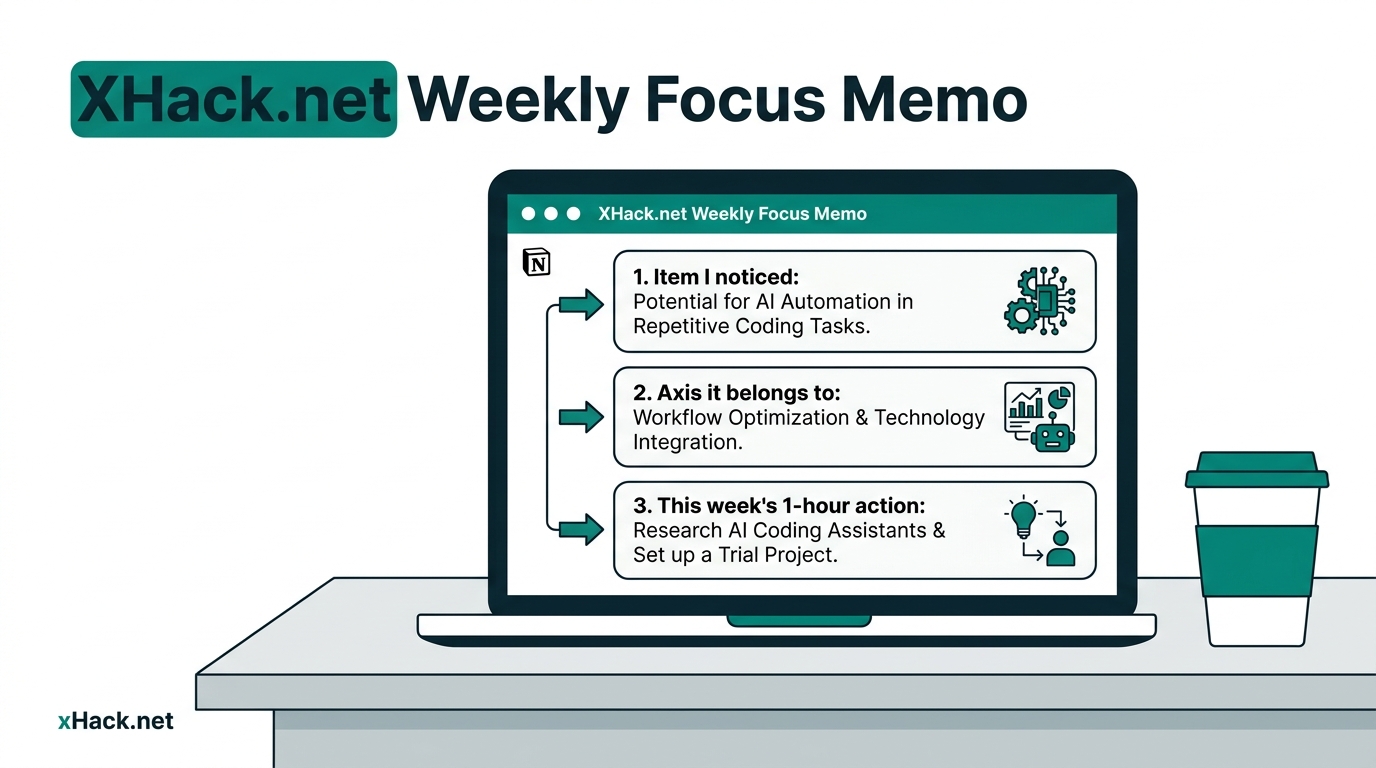
What follows is a 3-line template for converting monthly reports into action. Stick it in Notion, a memo app, wherever you can see it.
1. The one item from this month's report that caught my attention most (write just 1)
2. Which axis does it belong to (AI search / video social / ad automation)
3. What is one action I can move on within 1 hour this week (write just 1)
Each line: one thing only. If you want to write more, prioritize down to one.
Why 3 lines? Because past 4 lines, people stop executing.
Adding actions increases cognitive load. The marketing world has an infinite supply of “things you should do,” so it will expand if you let it. Cutting is far harder than adding.
What I’ve seen repeatedly in client work: adding “to-do’s” produces no results, while cutting “to-do’s” produces results. That simple law holds.
The 3-line template is a cutting device.
Concretely, it looks like this:
1. Item from this month's report: "AI Overview citation is the new ranking"
2. Axis: Axis 1 (AI search)
3. Action this week: Take my top traffic article and rewrite so the conclusion lands within the first 120 characters
Once it’s this specific, you can move. Next week’s you, in a one-hour block on Tuesday morning, can finish it. When you’re done, write your “week 2” template.
Run this cycle every month, and within 6 months you’ll start to see patterns: “which axis tends to be our bottleneck.” Once you see that, reading next month’s report takes 10 minutes.
Conclusion — One Action Over 12 Changes
ALM Corp’s May 2026 report covers 12 changes comprehensively. Reading it gives you the industry map in your head.
Then to connect it to your own moves, there’s only one thing to do:
- Fold the 12 items into 3 axes (AI search / video social / ad automation)
- Pick the 1 axis that matches your bottleneck
- Use the 3-line template to decide on one action within 1 hour this week
That’s it.
The moment you think “I have to chase all of them,” nothing moves. Conversely, the moment you decide “I’m narrowing to 1,” you can see the shape of next week’s self, in action.
Google Marketing Live is coming up on May 20th. That will probably surface another 10 or 20 new changes. If you respond to that as “the 12 became 30,” you’ll freeze again. Keep folding with the 3-axis template. The axes don’t change.
The fork between “those who master it” and “those it masters” is right here. Stand on the side that narrows and acts, not the side that chases information.
This week I’m running Axis 1 (AI search) — reviewing article structure for AI citation. Which axis will you choose?

AIを使いこなせない方は、この先どんどん差がつきます。僕はAIエージェントを毎日動かして、壊して、直して、また動かしてます。そういう泥臭い実践の記録をここに書いてます。理論は他の方にお任せしました。僕は動くものを作ります。朝5時に起きてウォーキングしてからコードを書くのがルーティンです。