You've Run Plenty of Campaigns. So Why Aren't They Working? The 2026 Web Marketing Survey (739 Marketers) Reveals the One Behavioral Pattern All Struggling Companies Share
The same social ads: 23% success, 17% failure. WINDOM's 2026 survey across 739 web marketing professionals reveals what separates winning companies from stalled ones — with a 5-question self-audit.
What you'll learn in this article
- The key point to grasp before reading the full article
- How the issue changes practical decisions after reading
- Which follow-up article is worth opening next
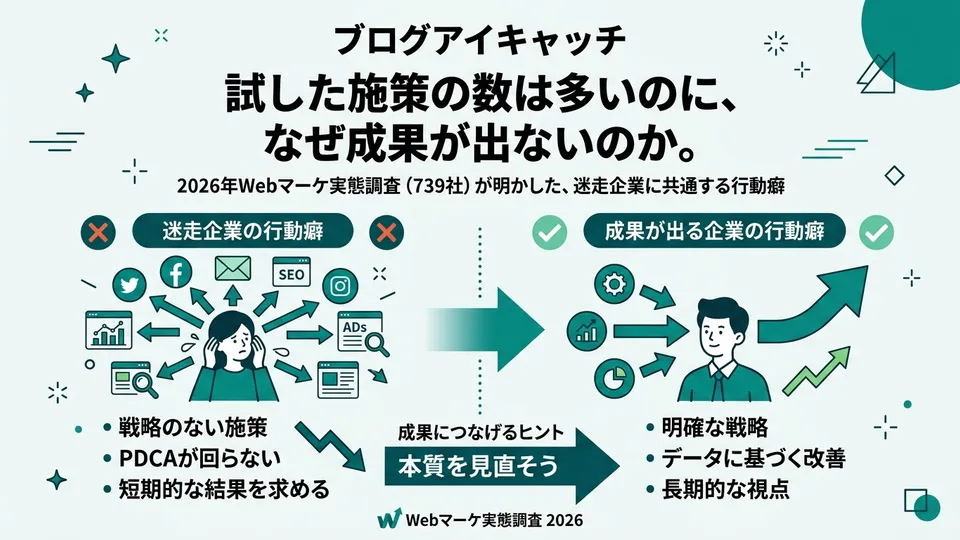
Most companies have tried a decent number of marketing tactics. SEO, social ads, search ads, content marketing — the majority have run them all.
And yet results don’t come. The problem isn’t that they haven’t tried enough.
In 2026, WINDOM Corporation conducted a reality survey of 739 web marketing professionals. The data gave a clear answer to this question. What separates “successful companies” from “companies that spin out” is not which tactics they use. It is what they decide before they execute — nothing more.
(Source: WINDOM Corporation “2026 Web Marketing Reality Survey” https://windom-kk.co.jp/news/978/)
Social Ads Are Both the #1 Success Tactic and the #1 Failure Tactic
The first number that jumps out of the WINDOM survey is a strange one.
The #1 “most successful tactic” was social advertising (23.0%). Yet the #2 “worst cost-effectiveness tactic” was also social advertising (16.7%).
The same tool, the same market — opposite results.
Search ads tell the same story. #2 “most successful tactic” (16.2%), and simultaneously #1 “worst-performing tactic” (18.5%). There is no inherent superiority between tactics. What exists is only a difference in how they are used.
So where does that difference come from?
When asked about the “biggest failure factor for tactics that didn’t deliver,” #1 was “weak creative/messaging (20.3%).” #2 was “strategy mismatch (target / value proposition / positioning) (18.5%).”
Pause here. Why was the creative weak? The reason targeting missed is rooted in the same place.
“The creative was weak” is a result, not a cause. Without a clear standard for evaluating creative, you can keep pouring ad spend into something weak without noticing. The failure factor that exists before the stated failure factors — that is the true dividing line between successful and struggling companies.
Among 2026’s intended focus tactics, social advertising ranked #1 (10.0%) and search ads #2 (8.1%). Many companies plan to put more budget into the same tactics that already hurt them. Without changing the design, the same results are waiting.
The Behavioral Difference — Whether You Define “What to Measure” First
What separates successful companies from struggling ones sits in the stage before a tactic begins.
Here is how struggling companies move: they try social ads because a competitor is running them. They leave creative to a designer, judge “it didn’t work” a month later, and pull out. Then they look for the next tactic. This cycle repeats.
Successful companies work differently. First they articulate: “What would have to change for this tactic to be a success?” Is it click-through rate? Conversion rate? Customer acquisition cost? They set the measurement axis before moving. Creative improvements follow that same axis.
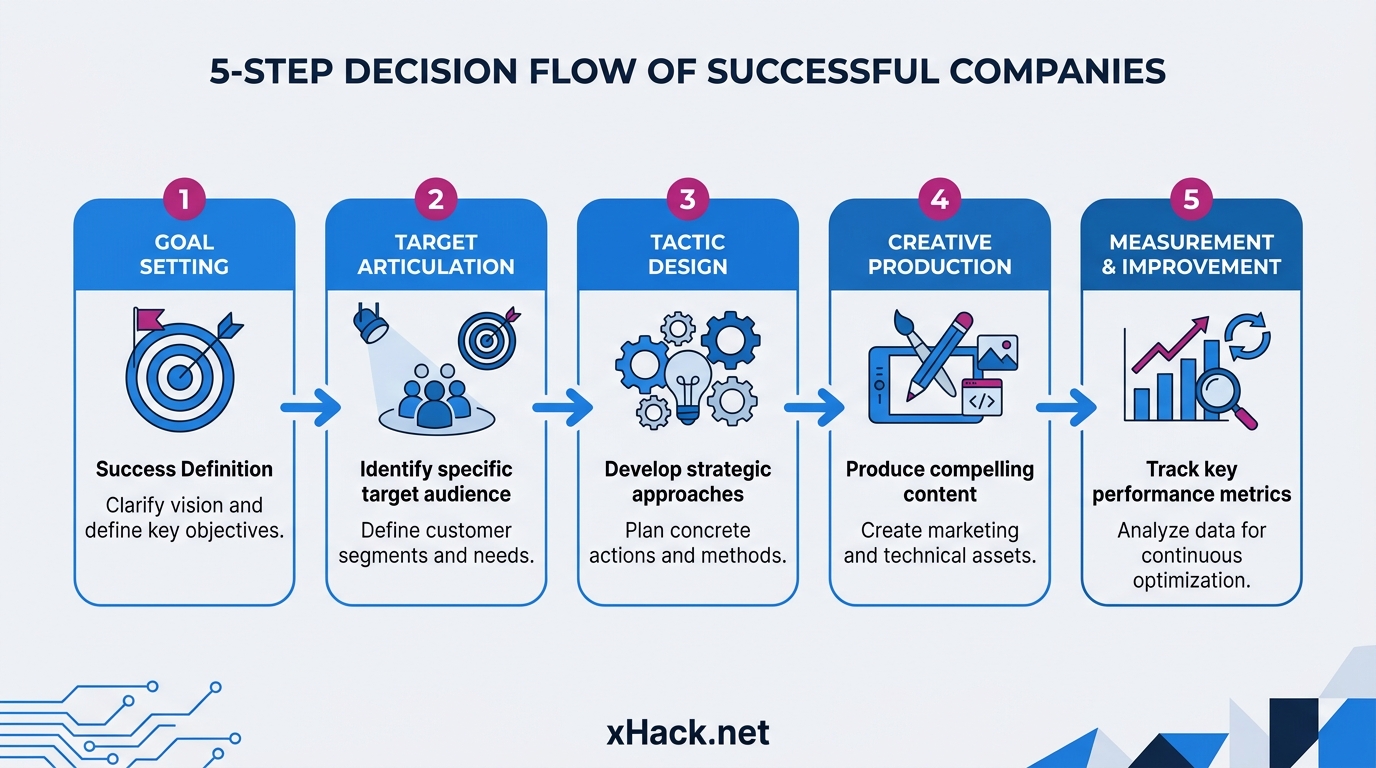
This is where weak creative and strategy mismatch are born. Without a measurement axis, creative becomes “whatever looks good,” and targeting expands to “roughly everyone.” A message that reaches nobody gets made.
What the survey data shows is not a tactic problem. It is that the presence or absence of design before the tactic begins determines success or failure.
Consider a solo marketer at a small company who reported: “We tried social ads last month but they didn’t work.” The standard for judging “didn’t work” was a gut feeling that inquiries hadn’t increased. Gut feeling is not measurement. That’s exactly why results can’t appear.
The Anatomy of Failure — 5 Types of Struggling Companies
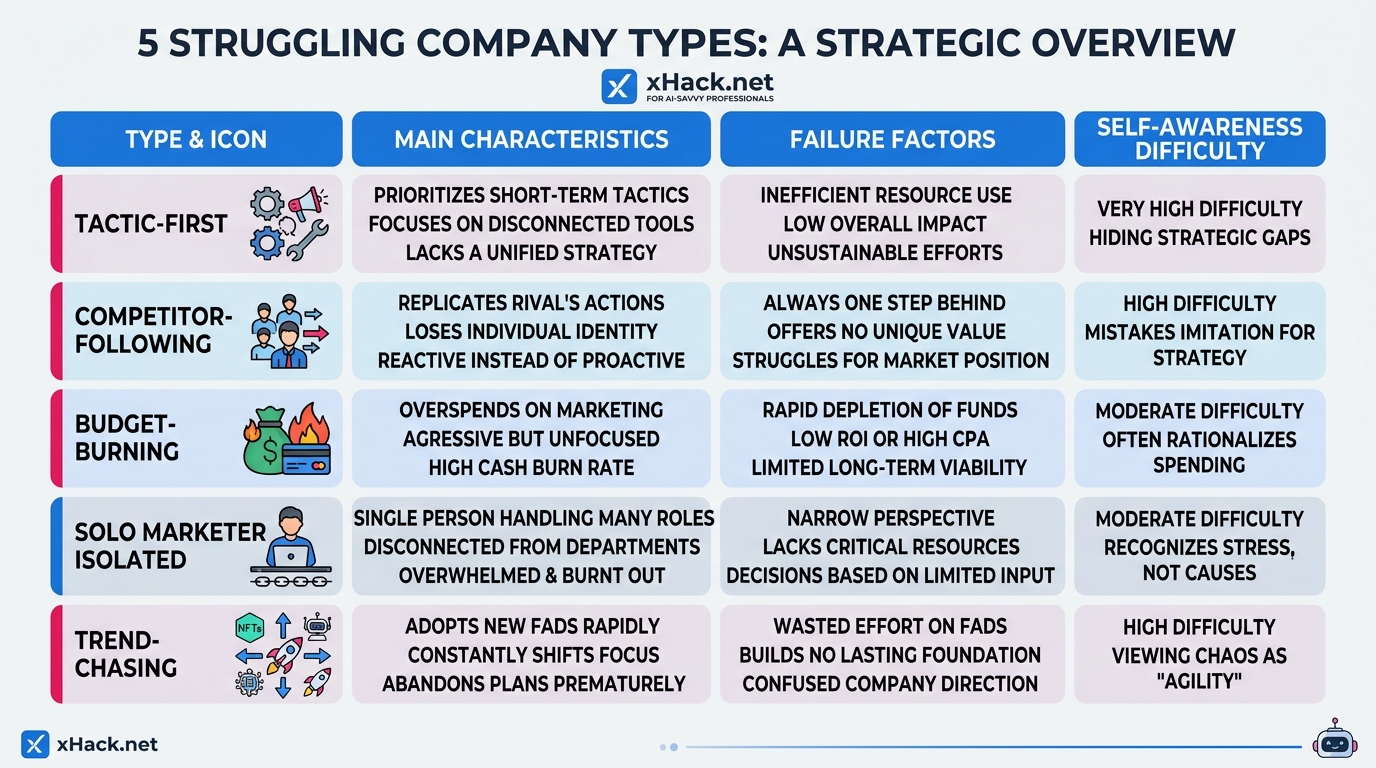
Reading across the 739-company data, five behavioral patterns consistently appear in struggling companies.
The Tactic-First Type “Try it and see” is their motto. They start tactics without setting measurement metrics. A month later, numbers come in but there’s nothing to compare against. The response is “numbers seem lower than expected” — and that’s the end of it.
The Competitor-Following Type “Because competitors are doing it” is the decision basis. Even though their own target, value proposition, and positioning differ from competitors’, they copy only the tactic. This is the main cause of strategy mismatch (18.5%).
The Budget-Burning Type Budgets are left at year-end. “If we don’t use it, next year’s budget gets cut” drives the tactic decision. Purposeless tactics produce no results. The most dangerous type — they feel satisfied having spent the budget even when results fail.
The Solo Marketer Isolated Type A solo marketer is running the tactics but can’t show results in numbers to decision-makers. Without a functioning standard for continue-vs-stop decisions, they default to “just keep going” or “just stop.” The improvement cycle for tactics never runs.
The Trend-Chasing Type Enthusiastic about gathering information on new tactics, but never touches the improvement of existing ones. They read articles and feel satisfied — execution stays stopped. Knowledge accumulates while action halts.
Does any of these types feel familiar for your company? If multiple types overlap, pick the single one that fits best and move to the next section’s diagnostic.
5-Question Self-Audit for Your Company
Five honest questions. Answer them directly.
Q1: Before starting a tactic, do you articulate the “definition of success”?
What number changing by what percentage would count as “it worked”? Do you decide this before the tactic begins? If not, all judgment about creative evaluation and improvement decisions runs on gut feel. That’s the true root of failure factor #1 (weak creative/messaging, 20.3%).
Q2: Can you articulate your target at the level of “challenge / role / situation”?
“30-something business professionals” isn’t enough. Can you write: “A solo web marketer at a 5-person company who can’t explain results to their CEO and is stuck”? If not, your creative message won’t land for anyone. Failure factor #2 (strategy mismatch) is born from rough target definition.
Q3: How many creative A/B tests did you run last month?
Failure factor #1 is “weak creative/messaging (20.3%).” Creative doesn’t land on the first try. Is your improvement cycle running weekly or biweekly? If last month’s count was zero, you’ve stopped addressing the top failure factor.
Q4: Who decides whether to continue or stop a tactic, based on what number, and when?
If you can’t answer all three parts instantly, continue-vs-stop decisions are happening “by feel.” When only the person running it is deciding subjectively, you’ll pull out of working tactics early and inertia-run non-working ones. The absence of decision criteria is the root cause of both the Budget-Burning type and the Solo Marketer Isolated type.
Q5: If you changed your tactic mix this year, can you explain why in one sentence?
“Competitors were doing it” and “my manager said so” are not reasons. Can you say: “We’re testing X because we have hypothesis Y about our problem Z”? If not, next year will bring the same tactic-change dynamic.
Scoring guide
Instant answers on all 5: your behavioral patterns are close to successful companies. Stuck on 3 or more: fix the design before adding new tactics. Each question you stumbled on becomes this week’s priority task.
For a full picture of the tactic landscape, see 2026 Digital Marketing: 12 Things Changed — this 5-question audit is designed as the “check your current position” follow-up to that article.
2026 Budget Allocation and Where AI Search Stands
The WINDOM survey also revealed the top intended focus tactics for 2026.
Social ads #1 (10.0%), search ads #2 (8.1%). Despite the fact that the top success tactics and top failure tactics overlap, many companies plan to concentrate budget on the same channels. Without changing the design, results don’t change.
What deserves attention: AI search optimization (SGE / AIO) intent sits at just 1.6%. The practice of optimizing for AI-driven citations — AEO and LLMO (LLM optimization) — is still at very early adoption.
This is where the second-half 2026 split happens.
Competition in mainstream tactics (social ads, search ads) is intense, and bid prices keep rising. The results you can generate from the same budget naturally decline. Meanwhile, AI search optimization rewards early movers with “AI recommendation slots.” The competitive field is thin now — which makes it the right moment for early investment.
AI search-driven traffic is already growing. Data showing Gemini referral traffic up 388% year-over-year (/en/blog/n2026032700002401/) confirms this trend was moving even at survey time.
Anthropic’s AI agent workflows rolled out for small businesses (/en/blog/n2026051600016901/) are also worth examining from a marketing operations efficiency angle. “Reducing the labor cost of running tactics” via AI is becoming the option that solo marketers in second-half 2026 need to reach for.
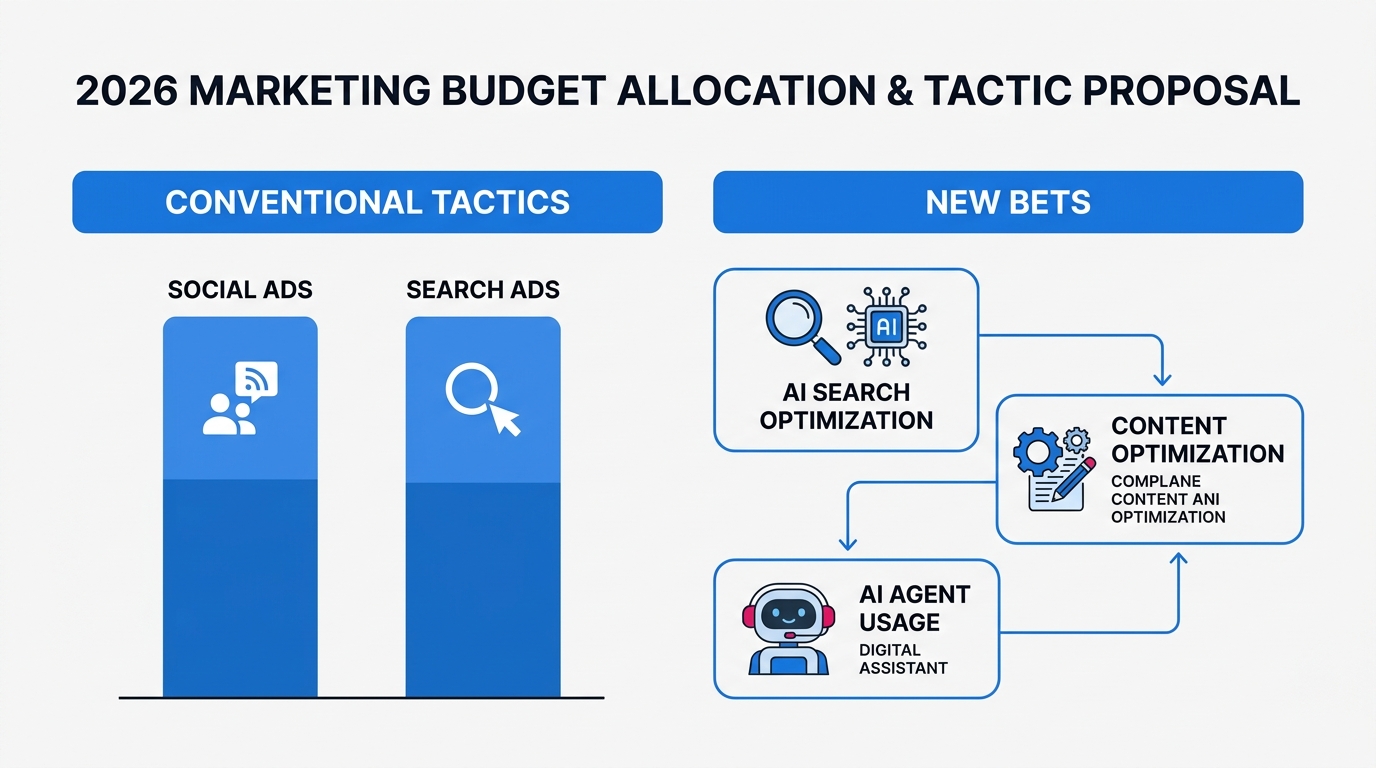
For solo marketers moving now, the priority is raising the design quality of existing tactics first. Fix wherever the 5-question audit stalled, then allocate budget to new tactics. Keep that order and the same budget produces different results.
Closing — The First Move to Stop Spinning Out
The core finding of the WINDOM survey (739 professionals) can be stated in one line: “Design comes before the tactic.”
Failure factor #1 “weak creative/messaging (20.3%)” and #2 “strategy mismatch (18.5%)” share a common root. Both are problems preventable at the stage before a tactic begins.
Define a measurement axis. Articulate the target. Build a mechanism for running an improvement cycle. Companies with those three in place are the ones generating 23% success rates with the same social ads.
If you’re choosing a first move today, take the one question from the 5-question audit where you got stuck — and put it into words this week.
- Stuck on Q1: Write the “definition of success” for your current tactic in 3 lines
- Stuck on Q2: Write your target as “challenge / role / situation” in one paragraph
- Stuck on Q3: Create one alternative version of your most recent creative
- Stuck on Q4: Put the continue/stop decision criteria in writing as “who / looks at what / by when”
- Stuck on Q5: Write the reason for your next tactic choice in one sentence
Fix the design before adding more tactics. That’s the shortest route out of spinning out.
As I wrote in Same Social Ads, Why One Company Wins and Another Sinks: “execution design” comes before tactic selection. Use today’s audit to confirm where your company stands.
One hour of design work before you launch a tactic. That one hour changes next month’s results.
Sources
- WINDOM Corporation “2026 Web Marketing Reality Survey — The Difference Between Successful and Struggling Companies Revealed”: https://windom-kk.co.jp/news/978/
- WINDOM Corporation “2026 Web Marketing Investment Trends” (PR TIMES): https://prtimes.jp/main/html/rd/p/000000003.000176801.html

AIを使いこなせない方は、この先どんどん差がつきます。僕はAIエージェントを毎日動かして、壊して、直して、また動かしてます。そういう泥臭い実践の記録をここに書いてます。理論は他の方にお任せしました。僕は動くものを作ります。朝5時に起きてウォーキングしてからコードを書くのがルーティンです。